Abstract
Social work has historically balanced commitments to both individual care and collective reform. Over the last century, the field’s integration into health and behavioral health systems has emphasized clinical treatment over social reform. This article argues for the reclamation of macro-level systems innovation as central to contemporary social work. Drawing from the field’s historical foundations and emerging research, it examines the growing phenomenon of aging in recovery—a population of older adults with long-term substance use recovery histories—through both national and preliminary New York State data. Results from an exploratory survey of over 200 adults in long-term recovery reveal significant anticipated service needs, including assistance with daily living, healthcare navigation, and social reconnection. The findings highlight a growing service gap and call for community-based, systems-level responses grounded in social work’s historical reformist tradition.
Introduction
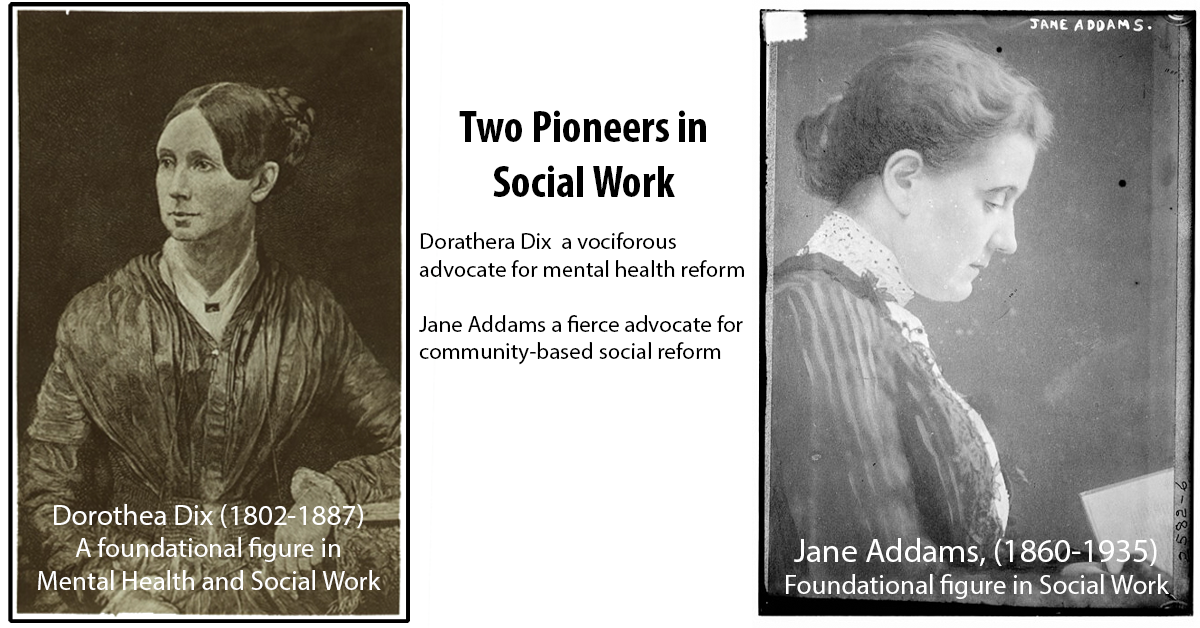
Social work has always functioned at the juncture of individuals and social systems. Its early architects—Jane Addams, Mary Richmond, and Dorothea Dix—understood that individual well-being emerges from collective well-being (Addams, 1910; Dix, 1843/2006). Over the twentieth century, professionalization shifted the field toward individual, clinically framed service provision (Gelman, 2015). This realignment strengthened clinical legitimacy but reduced attention to macro and community practice—precisely as populations and problems became more systemic and interdependent.
Today, issues such as immigration, systemic inequality, and the aging recovery population illustrate the limitations of a purely clinical lens. The need to renew macro practice within social work is not optional; it is existential. As McBeath (2023) notes, reclaiming macro social work entails “reenvisioning the field’s scope of innovation across policy, community, and collaborative systems.”
Historical Foundations
Social work’s roots lie in reform and engagement, not just therapy. The settlement house movement, embodied by Jane Addams’s Hull House, was explicitly systemic—an early model of place-based service integration, community empowerment, and social reform (Blank, 2013). Similarly, Dorothea Dix’s nineteenth-century mental health advocacy influenced U.S. institutional policy long before social work became a formal profession.
Flexner’s (1915) influential critique of social work as “not a profession” ushered in a shift toward evidence-based, medicalized practice frameworks. While this bolstered the profession’s legitimacy, it also narrowed its perceived mission. Over a century later, the challenge is to reassert that social work’s legitimacy must derive as much from systemic impact as from clinical expertise.
The Expansion of Clinical Practice
Throughout the mid- to late twentieth century, social work’s alignment with psychological and healthcare models expanded rapidly. The profession became integral to hospitals, treatment programs, and managed care systems. However, this integration entrenched an individualized service model that often separated social workers from their community-organizing roots (Reisch, 2019).
Recent workforce analyses by the National Association of Social Workers (2021) and the Association of Social Work Boards (2025) underscore this imbalance. The majority of social workers nationally now practice in behavioral health or healthcare settings, while fewer than 15 percent identify macro, policy, or community organizing as their primary domain. This shift raises pressing concerns about the profession’s ability to address emerging systemic issues such as aging, health equity, and migration policy.
Emerging Challenge: Aging in Recovery
The Service Gap
An under-examined population—adults aging in long-term recovery from substance use—is growing rapidly across the United States, particularly in states like New York that host large urban recovery communities. While millions sustain recovery for decades, systems designed to support aging populations rarely account for the unique needs of individuals with sustained recovery histories.
Federal research underscores this gap. SAMHSA (2020) notes that recovery supports are seldom age-tailored, and federal data collection rarely disaggregates by age within the recovery population. Complementary international research highlights similar trends: in Sweden, a twenty-year study of 1,200 + individuals post-treatment found that only 20 percent achieved both sustained recovery and economic stability, underscoring that social reintegration, not abstinence alone, predicts long-term wellbeing (Wennberg et al., 2025).
Practitioner Knowledge and Systems Response
Social work literature has begun to acknowledge this population’s needs. Shaw (2023) found that midlife and older women in recovery define success in relational and social terms—connection, belonging, and meaning—rather than in mere symptom absence. Jönson and Ha
Preliminary Findings: The New York State Aging in Recovery Survey
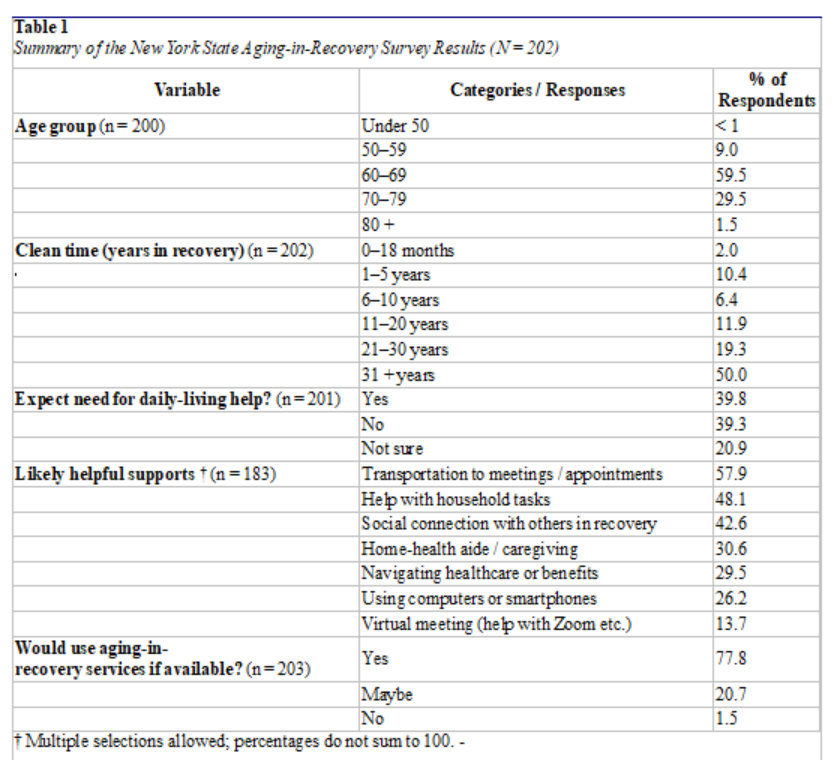
To explore the intersection of age, recovery, and service access, an exploratory survey was conducted in 2026 among 202 adults in sustained recovery residing across New York State. Participants were recruited through regional recovery community organizations.
Demographics and Recovery Duration
Of 200 respondents:
• 60–69 years = 59.5 %
• 70–79 years = 29.5 %
• 50–59 years = 9 %
• 80 + = 1.5 %
Half (50 %) reported 31 + years of sobriety or recovery; another 19.3 % had 21–30 years. Only 2 % had less than 18 months. This aging, well-established cohort represents a significant segment of recovery communities.
Anticipated Functional Needs
• 39.8 % expect to need daily living assistance as they age.
• 39.3 % do not; 20.9 % are unsure.
Most desired future supports: transportation (57.9 %), household help (48.1 %), social connection (42.6 %), home health aide (30.6 %), and healthcare/benefit navigation (29.5 %).
Programmatic Interest
76 %–78 % said they would use services designed for people aging in recovery; only 1.5 % said no.
Implications for Macro Social Work Practice
1. System Integration – Cross-sector frameworks linking aging, recovery, housing, and health care are essential. Social workers can lead coordination and advocacy across systems.
2. Program Design and Leadership – Develop aging-in-recovery initiatives blending peer support, functional aid, and social engagement (see Prochnow et al., 2025).
3. Education and Workforce Development – Expand curricula to include macro competencies—policy analysis, systems navigation, and community organizing.
Conclusion
The phenomenon of aging in recovery challenges social work to revisit its original balance between care and reform. Preliminary New York data reveal consistent, unmet needs among older adults long in recovery. Integrating this population into mainstream aging services demands a revitalized macro practice agenda. By combining clinical expertise with systemic imagination, social work can once again serve as both a healing and reforming profession.
References
Addams, J. (1910). Twenty years at Hull-House: With autobiographical notes. Macmillan.
Blank, B. T. (2013, December 12). Settlement houses: Old idea in new form builds communities. The New Social Worker. http://www.socialworker.com/feature-articles/practice/Settlement_Houses%3A_Old_Idea_in_New_Form_Builds_Communities/
Dix, D. (1843/2006). Memorial to the legislature of Massachusetts. Gale Group.
Flexner, A. (1915). Is social work a profession? University of Chicago Press.
Gelman, C. R. (2015). Clinical social work practice in the twenty-first century: A changing landscape. Clinical Social Work Journal, 43(3), 257–262. https://doi.org/10.1007/s10615-015-0550-5
Jönson, H., & Harnett, T. (2023). Age logics in social work: The case of harm reduction for 50 + with long-term substance misuse. Innovation in Aging, 7(Suppl 1), 715716. https://pmc.ncbi.nlm.nih.gov/articles/PMC10738396/
McBeath, B. (2023). Re-envisioning macro social work practice. Portland State University.
National Association of Social Workers. (2021). NASW workforce report. NASW Press.
Prochnow, T., Patterson, M. S., Francis, A. N., Pew, S. H., Liu, S., Kang, Z., & Heinrich, K. M. (2025). Exploring support provision for recovery from substance use disorder among members of a sober active community. Scientific Reports, 15, 8740. https://doi.org/10.1038/s41598-025-92029-1
Reisch, M. (2019). Lessons from social work’s history for a tumultuous era. Social Service Review, 93(4), 581–611. https://doi.org/10.1086/706741
Shaw, A. (2023). Women in mid-life and older age in recovery from illicit drug use: Connecting and belonging. Frontiers in Psychiatry, 14, 1221500. https://doi.org/10.3389/fpsyt.2023.1221500
Substance Abuse and Mental Health Services Administration. (2020). Key substance use and mental-health indicators in the United States: Results from the 2019 National Survey on Drug Use and Health (HHS Publication No. PEP20-07-01-001).
The Association of Social Work Boards. (2025). The self-identified social work workforce: Analyses of the U.S. Census Bureau’s household surveys. https://www.aswb.org/wp-content/uploads/2025/07/Social-Work-Workforce-Study-Series-Report-1-1.pdf
Wennberg, P., Sohlberg, T., & Storbjörk, J. (2025). Measuring social integration, treatment, and mortality after substance use treatment: Methodological elaborations in a 20-year follow-up study. BMC Research Notes, 18, Article 27. https://doi.org/10.1186/s13104-025-07108-3