Abstract
“Aging in place” has become a dominant paradigm in gerontology and social policy, emphasizing independence, continuity, and cost-effective care. While widely promoted, this model is built on assumptions that do not universally apply—particularly for individuals aging in recovery from substance use disorders (SUDs). This article critically examines the conceptual foundations of aging in place, analyzes its structural limitations through a person-in-environment lens, and explores how the model fails to account for behavioral health dynamics. It argues that a reorientation toward stability-based and recovery-informed frameworks is necessary to address the needs of this population and to align aging services with contemporary social realities.
Introduction
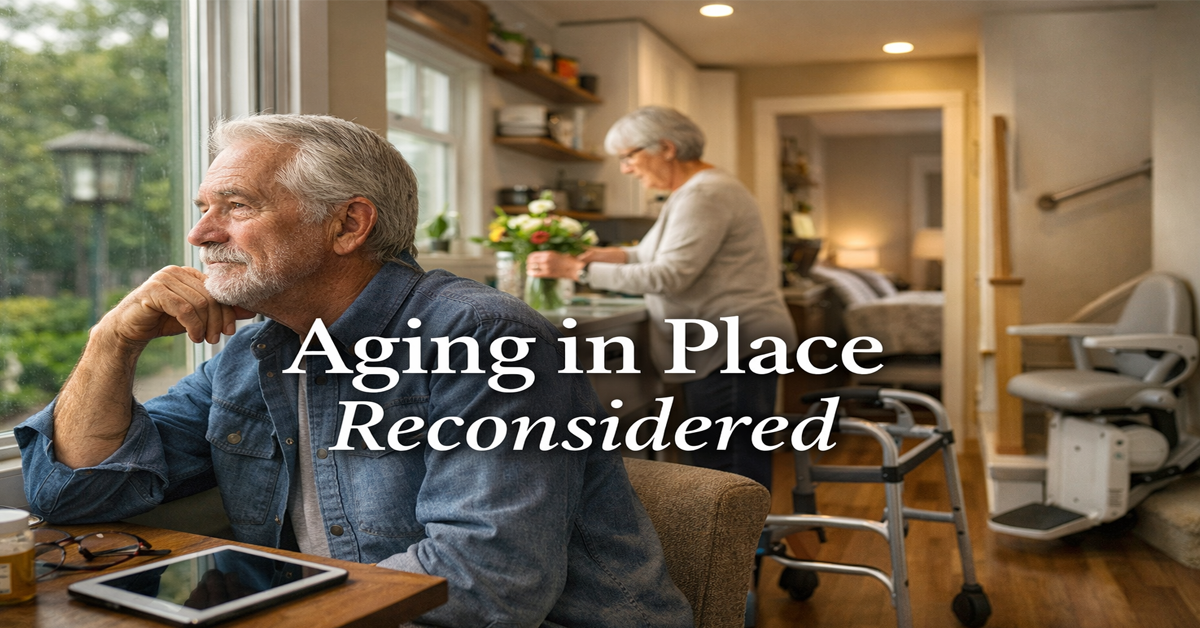
Aging in place is widely regarded as the preferred model of care for older adults in the United States. It is commonly defined as the ability to remain safely, independently, and comfortably in one’s home and community as one ages (Wiles et al., 2012).
This model is supported by both policy and practice for several reasons
- It aligns with individual preferences for independence
- It is often more cost-effective than institutional care
- It promotes continuity of environment and identity
However, the model is built on a set of underlying assumptions that are not universally valid.
For individuals aging in recovery, these assumptions warrant closer examination.
Conceptual Foundations of Aging in Place
The aging-in-place model is grounded in a combination of gerontological theory and policy priorities. It reflects an emphasis on autonomy, environmental familiarity, and the preservation of social ties (Centers for Disease Control and Prevention [CDC], 2021).
Implicit within this framework are several assumptions
- The home environment is stable and supportive
- Social networks are accessible and functional
- The individual’s needs are primarily physical or functional
While these assumptions hold true for many older adults, they do not fully account for the complexities associated with long-term recovery.
Person-in-Environment Analysis Beyond Physical Space
From a social work perspective, the effectiveness of any care model depends on the interaction between individuals and their environments (Hutchison, 2019).
Aging in place prioritizes physical location, but it does not inherently account for the qualitative aspects of that environment.
For individuals in recovery, stability is influenced by factors that extend beyond physical safety, including
- Predictability of daily routines
- Access to recovery-oriented social networks
- Environmental cues that either support or undermine recovery
An environment can be physically safe yet psychologically or socially destabilizing.
This distinction is critical.
Structural Limitations for Individuals in Recovery
When applied to individuals aging in recovery, the limitations of the aging-in-place model become more apparent.
1. Exposure to Environmental Risk Factors
Home environments may include exposure to alcohol or other substances, either directly or indirectly. Unlike structured recovery settings, private homes are not designed to mitigate such risks.
2. Social Isolation
Aging in place can inadvertently increase isolation, particularly when mobility declines. Research indicates that social isolation among older adults is associated with increased behavioral health risks, including substance misuse and relapse (National Academies of Sciences, Engineering, and Medicine, 2020).
3. Disruption of Recovery Routines
Sustained recovery is often supported by structured routines, including regular participation in peer-based activities. Aging-related limitations may disrupt these routines, particularly when transportation or accessibility becomes an issue.
4. Lack of Recovery-Informed Support
Home-based care providers are typically trained in physical care but may lack knowledge of recovery principles. This can result in care that meets functional needs while overlooking factors critical to maintaining stability.
These limitations reflect a broader issue: the model does not account for behavioral health as an ongoing, dynamic component of well-being.
Policy and System Implications
The widespread adoption of aging in place is supported by policy frameworks that prioritize cost containment and individual autonomy.
While these goals are important, they have contributed to a narrow definition of care that focuses on physical needs.
This creates a policy gap
- Behavioral health is under-integrated
- Recovery is not recognized as a lifelong process
- Service models lack the flexibility to address complex needs
From a systems perspective, this represents a misalignment between policy objectives and lived realities.
Reframing the Model From Place-Based to Stability-Based Care
Addressing these limitations requires a conceptual shift. Rather than defining care solely by location, a more effective approach is to focus on stability.
Stability-based care emphasizes
- Consistency of environment
- Access to supportive relationships
- Alignment between individual needs and environmental conditions
For individuals aging in recovery, this includes
- Access to peer support, whether in-person or virtual
- Environments that minimize exposure to substances
- Care providers trained in recovery-informed approaches
This reframing does not reject aging in place, but expands it.
Application to Aging in Recovery
The concept of aging in recovery provides a framework for applying this expanded perspective.
It recognizes that
- Recovery is a lifelong process
- Stability is influenced by both internal and external factors
- Systems must adapt to support changing needs
Integrating this framework into aging services requires
- Cross-sector collaboration
- Workforce development
- Policy adjustments that incorporate behavioral health considerations
These changes reflect a move toward more holistic, integrated models of care.
Aging in place remains a valuable and widely supported model. However, its current formulation is incomplete.
By prioritizing physical location and independence, it overlooks the complex interplay of factors that influence stability—particularly for individuals in recovery.
Reconsidering aging in place through a person-in-environment lens highlights the need for more nuanced, adaptable models of care.
Aging in recovery underscores this need.
Expanding the framework to include behavioral health and recovery-informed principles is not only beneficial—it is necessary for aligning services with the realities of an aging population.
Conclusion
Aging in place remains a valuable and widely supported model. However, its current formulation is incomplete.
By prioritizing physical location and independence, it overlooks the complex interplay of factors that influence stability—particularly for individuals in recovery.
Reconsidering aging in place through a person-in-environment lens highlights the need for more nuanced, adaptable models of care. These changes reflect a move toward more holistic, integrated models of care.
Aging in recovery underscores this need.
Expanding the framework to include behavioral health and recovery-informed principles is not only beneficial—it is necessary for aligning services with the realities of an aging population.
References
Centers for Disease Control and Prevention. (2021). Healthy aging, aging in place.
Hutchison, E. D. (2019). Dimensions of human behavior: Person and environment (6th ed.). SAGE Publications.
National Academies of Sciences, Engineering, and Medicine. (2020). Social isolation and loneliness in older adults: Opportunities for the health care system.
Wiles, J. L., Leibing, A., Guberman, N., Reeve, J., & Allen, R. E. S. (2012). The meaning of “aging in place” to older people. The Gerontologist, 52(3), 357–366.