Trauma, Aging, and System Implications for Recovery-Oriented Care
Abstract
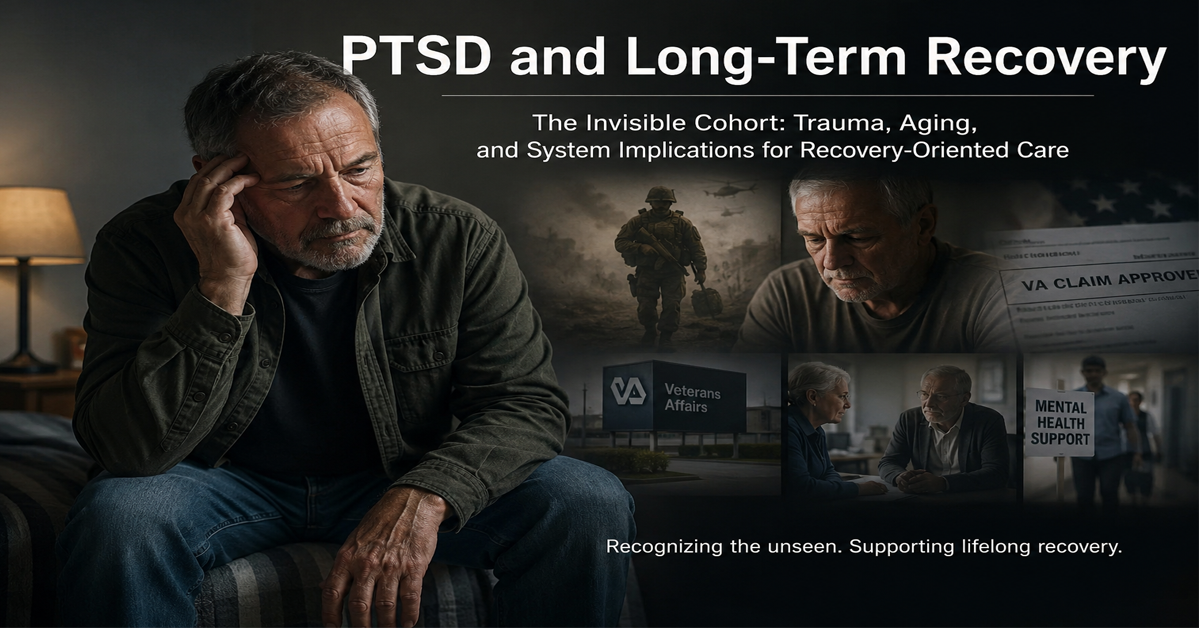
This article examines the relationship between post-traumatic stress disorder (PTSD), substance use disorders (SUD), and long-term recovery among older adults. Emerging evidence suggests that many individuals aging in long-term recovery continue to experience unresolved trauma symptoms decades after achieving sobriety. Despite growing research on PTSD and SUD, older adults in sustained recovery remain underrepresented in service design and policy discussions. This article explores trauma exposure, PTSD prevalence, aging-related stressors, and the implications for recovery-oriented social work practice and system design. The discussion situates these issues within the broader concept of the “Invisible Cohort,” referring to the large but insufficiently recognized population of individuals aging in long-term recovery.
Introduction
Research consistently demonstrates high rates of trauma exposure among individuals with histories of substance use disorders (SUD). Numerous studies estimate that between 25% and 50% of individuals with SUD histories also meet diagnostic criteria for post-traumatic stress disorder (PTSD) at some point in their lives (Blanco et al., 2013). Trauma exposure frequently predates substance use, supporting the widely discussed self-medication hypothesis in addiction research.
Individuals exposed to chronic trauma may use alcohol, opioids, stimulants, or other substances to regulate intrusive memories, anxiety, hypervigilance, emotional dysregulation, or sleep disturbances. Over time, repeated substance use may evolve into dependency and addiction. Although recovery can interrupt active substance use, recovery itself does not necessarily eliminate trauma-related symptoms.
This distinction is critically important when examining individuals aging in long-term recovery.
Trauma and Long-Term Recovery
Recovery literature frequently emphasizes abstinence, social reintegration, and improved quality of life. However, less attention has historically been devoted to the persistence of trauma symptoms among older adults who have sustained decades of sobriety.
Long-term abstinence does not necessarily indicate resolution of trauma-related symptoms. Many individuals aging in recovery continue to experience:
- hypervigilance
- emotional suppression
- insomnia
- social withdrawal
- distrust
- anxiety-related symptoms
These experiences may remain hidden beneath otherwise stable lives and successful recovery trajectories.
Emerging geriatric mental health literature suggests that PTSD symptoms may intensify or re-emerge during later life due to:
- retirement
- grief
- declining health
- reduced mobility
- social isolation
- loss of peer networks
For individuals aging in recovery, these transitions may destabilize coping mechanisms that were sustained through work structure, community participation, or recovery meetings.
The National Academies of Sciences, Engineering, and Medicine (2020) identified loneliness and social isolation as significant public health concerns among older adults. For individuals with trauma histories, isolation may further exacerbate unresolved PTSD symptoms.
Estimated PTSD and SUD Findings
FindingEstimated RateLifetime PTSD among people with SUD histories25–50%Trauma exposure among SUD populationsApproximately 75%PTSD prevalence among U.S. adultsApproximately 6% lifetimeIndividuals reporting significant adverse childhood experiences among SUD populationsSubstantially elevated
Aging in Recovery and the “Invisible Cohort”
Public discourse surrounding addiction frequently focuses on acute addiction, homelessness, incarceration, and visible social instability. While these realities remain important, they do not fully represent the diversity of people in long-term recovery.
Many individuals who found recovery during the 1980s and 1990s rebuilt families, developed careers, purchased homes, paid taxes, and became productive members of society. This population includes:
- social workers
- physicians
- teachers
- business professionals
- laborers
- tradespeople
- retirees
- caregivers
Despite these achievements, many remain largely invisible within aging systems.
The phrase commonly heard within recovery communities—“from park bench to Park Avenue”—captures the reality that addiction and recovery transcend social class boundaries. Recovery communities have historically recognized this reality more fully than many public systems.
As these individuals age, unresolved trauma may coexist with otherwise successful recovery outcomes.
Common Trauma-Related Symptoms in Long-Term Recovery
SymptomObserved ConcernHypervigilancePersistent anxiety and alertnessSleep disturbancesChronic insomnia or nightmaresSocial isolationWithdrawal from social engagementEmotional suppressionDifficulty processing traumaDistrustDifficulty forming supportive relationshipsGrief reactivationTrauma responses triggered by aging-related losses
Systems Implications for Social Work and Aging Services
Existing aging systems often fail to integrate trauma-informed and recovery-informed approaches simultaneously. Behavioral health systems traditionally focus on acute treatment and stabilization, while aging services frequently emphasize physical decline and medical management.
Individuals aging in long-term recovery may fall between these systems.
For example:
- many no longer identify with traditional treatment environments
- some may avoid mental health systems due to stigma
- others may rely exclusively on peer-based recovery support
As the aging recovery population grows, social workers and policymakers may need to address:
- unresolved trauma
- transportation barriers
- healthcare navigation
- social isolation
- peer connection
- technology access
- grief and identity transitions
These needs extend beyond traditional clinical treatment and suggest the importance of integrated community-based approaches.
Implications for the Aging in Recovery Resource Model (ARRM)
The proposed Aging in Recovery Resource Model (ARRM) attempts to address these emerging gaps through a layered framework integrating:
- individual recovery support
- peer and workforce supports
- coordinated continuum-of-care approaches
- policy and community integration
Within this framework, trauma-informed care becomes an essential rather than optional component.
ARRM does not assume that long-term sobriety eliminates trauma. Instead, it recognizes that individuals aging in recovery may continue to experience the physiological and psychological consequences of earlier trauma exposure decades after achieving abstinence.
This perspective aligns with broader social work principles emphasizing dignity, person-in-environment frameworks, and systems-oriented intervention.
Economic and Policy Considerations
The implications extend beyond behavioral health into economic policy and aging system design.
Institutional senior care and nursing facilities may cost thousands of dollars per week per resident in metropolitan regions. Community-based, recovery-informed support systems may help individuals remain safely in their homes longer while maintaining recovery stability and reducing social isolation.
This issue becomes increasingly important as the large recovery cohorts emerging from the 1980s and 1990s continue to age.
Failure to address these needs may contribute to:
- increased healthcare utilization
- worsening mental health outcomes
- isolation
- reduced quality of life
- avoidable institutionalization
Conclusion
The intersection of PTSD, aging, and long-term recovery represents an emerging systems issue for social work, aging services, and behavioral health policy. Although substantial research exists regarding trauma and substance use disorders, considerably less attention has been devoted to older adults in sustained recovery.
Many individuals aging in recovery continue to carry unresolved trauma despite decades of abstinence and social reintegration. Their experiences challenge simplistic understandings of recovery as merely the cessation of substance use.
As this population grows, recovery-informed and trauma-informed approaches may become increasingly necessary within aging systems.
The aging recovery population is not disappearing. It is aging.
References
Blanco, C., Xu, Y., Brady, K., Pérez-Fuentes, G., Okuda, M., & Wang, S. (2013). Comorbidity of posttraumatic stress disorder with alcohol dependence among U.S. adults. Drug and Alcohol Dependence, 132(3), 630–638.
Cloud, W., & Granfield, R. (2008). Conceptualizing recovery capital: Expansion of a theoretical construct. Substance Use & Misuse, 43(12–13), 1971–1986.
National Academies of Sciences, Engineering, and Medicine. (2020). Social isolation and loneliness in older adults: Opportunities for the health care system. National Academies Press.
National Institute of Mental Health. (2024). Post-traumatic stress disorder. https://www.nimh.nih.gov/health/topics/post-traumatic-stress-disorder-ptsd
Substance Abuse and Mental Health Services Administration. (2020). TIP 57: Trauma-informed care in behavioral health services. U.S. Department of Health and Human Services.
U.S. Department of Veterans Affairs. (2024). PTSD and substance use disorders in veterans. National Center for PTSD. https://www.ptsd.va.gov
World Health Organization. (2024). Post-traumatic stress disorder. https://www.who.int/news-room/fact-sheets/detail/post-traumatic-stress-disorder