Abstract
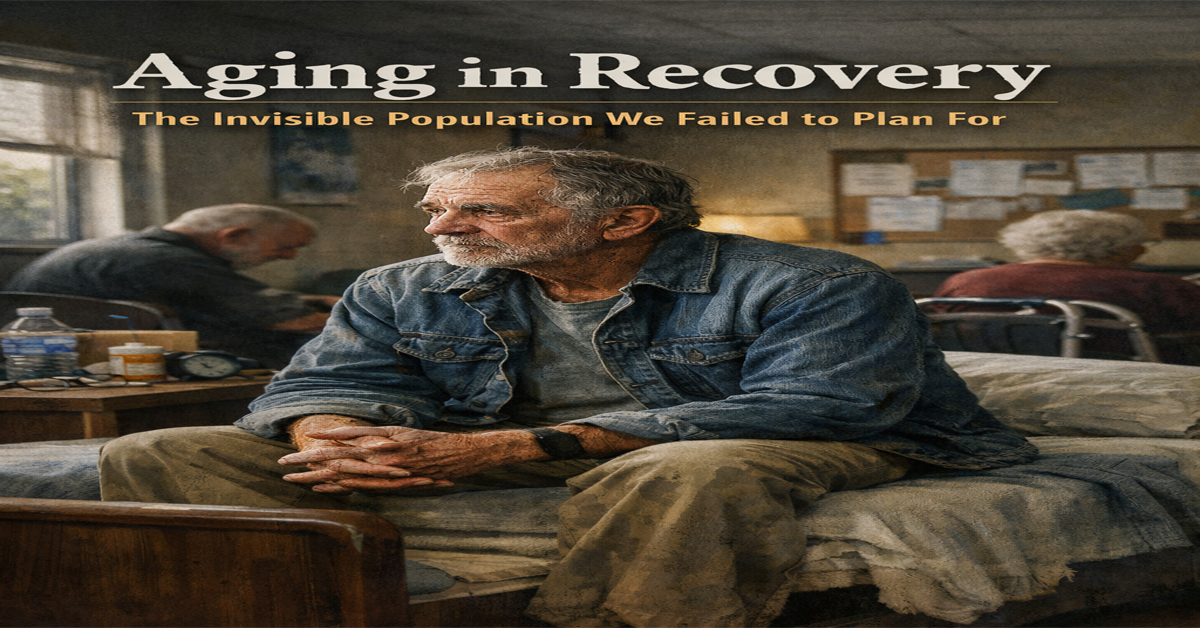
This article examines the emergence of a largely unrecognized population: individuals aging in long-term recovery from substance use. While substance use disorder (SUD) research has focused on active use and early recovery, less attention has been paid to those who achieve sustained recovery and enter later life. Drawing on recovery research, aging studies, and policy analysis, this article defines this “invisible cohort,” examines the structural gaps affecting them, and introduces the Addiction Recovery Residential Model (ARRM) as a framework for recovery-informed aging care.
Introduction
Substance use disorder (SUD) systems have historically focused on active addiction and early recovery. However, population-level evidence suggests that recovery is far more prevalent and enduring than commonly understood. An estimated 22 million Americans identify as being in recovery, with recovery prevalence increasing with age (Kelly et al., 2017).
This raises a critical and underexplored question: what happens to individuals after decades of sustained recovery as they age? Despite the scale of this population, current systems remain largely unprepared to address their needs. This article argues that individuals aging in recovery represent a distinct population—an invisible cohort—whose needs fall between addiction treatment systems and aging services.
Recovery as a Lifelong Trajectory
Recovery is increasingly understood as a dynamic, lifelong process rather than a discrete event. Individuals in long-term recovery demonstrate improved life satisfaction, meaning, and social integration over time (Kelly et al., 2017; Davidson et al., 2012). In later life, recovery becomes embedded in identity and sustained through routine, community, and purpose.
However, while recovery strengthens over time, it is not immune to disruption. Aging introduces new variables that existing recovery models do not adequately address.
The Invisible Cohort
Despite strong evidence supporting long-term recovery, aging systems rarely account for recovery history. Addiction systems focus on active use, while aging services emphasize physical decline and cognitive impairment. Neither system is designed for individuals who are stable in recovery yet navigating later life.
This structural omission creates an invisible cohort—individuals who are no longer in treatment, not actively using, and not recognized within aging services, yet remain vulnerable to destabilization.
Medical Complexity in Aging in Recovery
Individuals aging in recovery frequently present with chronic health conditions shaped by prior substance use and life course factors. These include cardiovascular disease, respiratory illness, neuropathy, hepatitis C, arthritis, and neurological disorders. Many also face serious conditions such as cancer and renal failure (Substance Abuse and Mental Health Services Administration [SAMHSA], 2020).
These conditions are not isolated from recovery. They intersect directly with recovery stability, particularly when treatment involves medications with addiction potential.
Prescription Medications as a Pathway to Relapse
Relapse in older adults increasingly occurs through medically prescribed substances rather than illicit drug use. Opioids, benzodiazepines, and sedative-hypnotics are commonly prescribed for legitimate conditions in older adults. However, for individuals in long-term recovery, these substances can reactivate neurobiological pathways associated with addiction and disrupt recovery stability (National Institute on Drug Abuse [NIDA], 2020; SAMHSA, 2020).
This represents a clinically initiated pathway to relapse—one that is often unrecognized within standard medical care.
Aging-Related Risk Factors
Later life introduces additional destabilizing factors, including social isolation, bereavement, loss of identity, and declining health. Loneliness, in particular, has been strongly associated with adverse health outcomes and increased vulnerability (Courtin & Knapp, 2017).
These factors differ significantly from traditional relapse triggers and require targeted, recovery-informed interventions.
System Fragmentation and Policy Failure
The failure to integrate recovery into aging services reflects broader systemic issues. Social work’s historical shift from macro-level advocacy to clinical practice contributed to a fragmentation of care (Addams, 1910; Richmond, 1917). As a result, recovery is not integrated into aging policy, and peer-based recovery models remain underutilized (White, 2009).
Toward a Recovery-Informed Model: ARRM
The Addiction Recovery Residential Model (ARRM) is proposed to address these systemic gaps. ARRM conceptualizes recovery as a lifelong trajectory requiring support across the lifespan.
Core principles include:
1. Recovery as a lifelong condition
2. Aging as a distinct phase of recovery
3. Recovery-informed healthcare and prescribing practices
4. Integrated care coordination
5. Preservation of dignity, identity, and independence
ARRM represents a shift from episodic treatment to lifespan-oriented recovery support.
Conclusion
Recovery does not end—it evolves. Millions of individuals aging in long-term recovery remain largely invisible within current systems. Addressing this gap requires integrating recovery into aging services and rethinking recovery as a lifelong process. ARRM offers a foundational framework for bridging this divide.
References
Addams, J. (1910). Twenty years at Hull-House. Macmillan.
Courtin, E., & Knapp, M. (2017). Social isolation, loneliness, and health in old age. Health & Social Care in the Community, 25(3), 799–812.
Davidson, L., Rowe, M., DiLeo, P., Bellamy, C., & Delphin-Rittmon, M. (2012). Recovery-oriented systems of care. Alcohol Research: Current Reviews, 34(4), 122–133.
Kelly, J. F., Bergman, B. G., Hoeppner, B. B., Vilsaint, C. L., & White, W. L. (2017). Prevalence and pathways of recovery. Drug and Alcohol Dependence, 181, 162–169.
National Institute on Drug Abuse. (2020). Substance use in older adults.
Richmond, M. (1917). Social diagnosis. Russell Sage Foundation.
Substance Abuse and Mental Health Services Administration. (2020). TIP 26: Treating substance use disorder in older adults.
White, W. (2009). Peer-based addiction recovery support.