and the Case for the Aging in Recovery Residential Model (ARRM)
Abstract
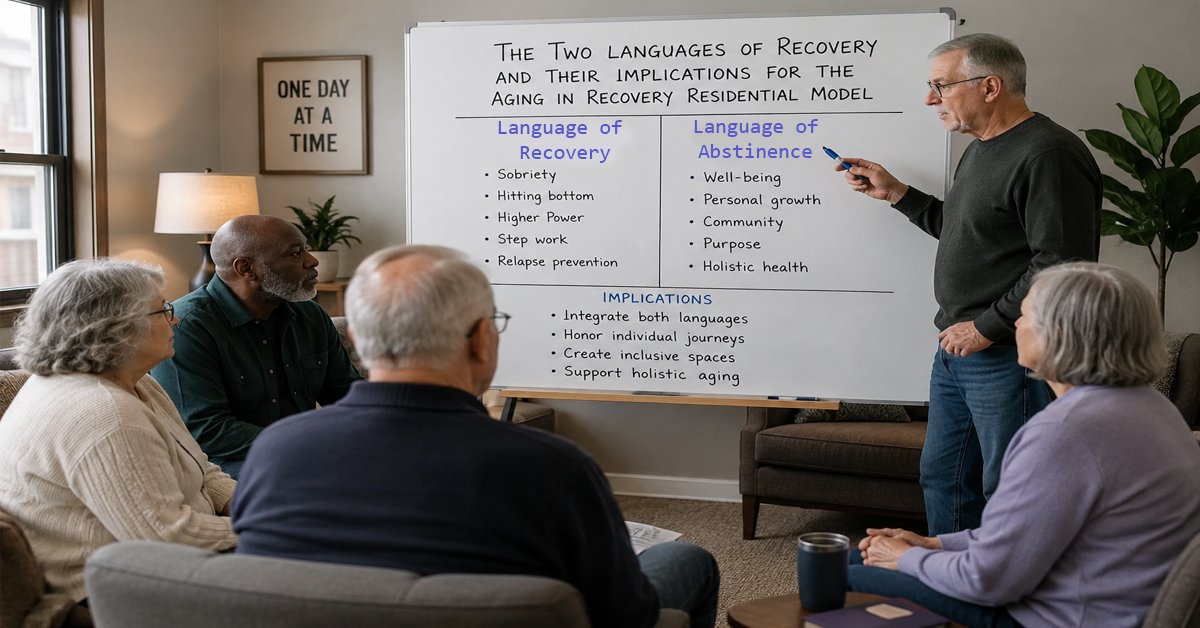
The field of substance use disorder (SUD) treatment and recovery support has evolved through two parallel but often disconnected languages. One language is rooted in professional and clinical systems, including psychiatry, psychology, medicine, behavioral health, and social work. This language emphasizes diagnosis, treatment modalities, evidence-based interventions, and measurable clinical outcomes. The second language emerges from lived experience and mutual-aid recovery communities such as Alcoholics Anonymous and Narcotics Anonymous. This language emphasizes identification, spiritual growth, surrender, service, hope, fellowship, and personal transformation. Although both languages seek recovery and improved quality of life, they often operate independently, creating barriers for older adults aging in long-term recovery. This article explores the historical and structural divide between these two languages and argues that the Aging in Recovery Residential Model (ARRM) offers a framework capable of integrating both perspectives into a comprehensive, recovery-oriented continuum of care for older adults.
Introduction
Over the last several decades, the United States has experienced profound changes in how substance use disorders are understood and treated. Clinical and medical systems increasingly frame addiction as a chronic disease requiring professional intervention, medication management, behavioral therapies, and evidence-based treatment protocols (McLellan et al., 2000). Simultaneously, millions of individuals have achieved long-term recovery through peer-driven mutual-aid movements grounded in lived experience rather than formal clinical treatment (Kelly et al., 2017).
These two systems often speak entirely different languages.
A physician may describe an individual as presenting with “opioid use disorder in sustained remission.” A person in recovery may instead describe themselves as “clean for 20 years.” A clinician may discuss relapse prevention planning and co-occurring disorders, while a recovering individual may discuss spiritual maintenance, meetings, sponsorship, and service work.
Neither language is inherently wrong. Both emerged from legitimate historical, professional, and cultural contexts. However, problems arise when systems fail to recognize that recovery itself is multidimensional and that older adults aging in recovery often navigate both worlds simultaneously.
This divide becomes particularly significant among older adults in long-term recovery who increasingly encounter aging systems unfamiliar with recovery culture and recovery systems unfamiliar with gerontology. The result is often fragmented care, misunderstanding, stigma, social isolation, and the erosion of recovery-supportive environments.
The Aging in Recovery Residential Model (ARRM) was developed to address this systemic gap by recognizing aging in recovery as a distinct population requiring specialized recovery-informed residential and community-based supports.
Historical Development of the Two Languages of Recovery
The Professional and Clinical Language
The professional language of addiction treatment evolved primarily through psychiatry, medicine, psychology, and public health. This language emphasizes:
- Diagnostic criteria
- Pathology
- Neurobiology
- Behavioral interventions
- Medication-assisted treatment
- Harm reduction
- Clinical stabilization
- Evidence-based practice
- Outcomes measurement
The publication of the Diagnostic and Statistical Manual of Mental Disorders (DSM) formalized addiction within psychiatric classification systems (American Psychiatric Association [APA], 2022). Medical professionals increasingly framed addiction as a chronic relapsing brain disease (Volkow et al., 2016).
Within this framework, professionals commonly use terminology such as:
| Professional Language | Meaning |
|---|---|
| Substance Use Disorder | Clinical diagnosis |
| Remission | Reduced or discontinued use |
| Relapse Episode | Return to substance use |
| Co-occurring Disorders | Simultaneous mental health and SUD conditions |
| Evidence-Based Intervention | Scientifically validated treatment |
| Medication-Assisted Treatment | Pharmacological support for recovery |
This language is essential for reimbursement systems, clinical coordination, public health policy, and interdisciplinary communication.
However, for many people in recovery, this language can feel detached from lived experience.
The Language of Recovery Communities
The second language developed largely outside formal institutions. Mutual-aid fellowships such as Alcoholics Anonymous and Narcotics Anonymous emerged from grassroots efforts emphasizing shared experience, mutual support, spirituality, accountability, and identity transformation.
This language includes terms such as:
| Recovery Community Language | Meaning |
|---|---|
| Clean/Sober | Abstinent from substances |
| One Day at a Time | Focus on daily recovery |
| Sponsor | Peer mentor |
| Fellowship | Recovery community |
| Higher Power | Spiritual framework |
| Service Work | Helping others in recovery |
| Hitting Bottom | Crisis leading to change |
| Recovery | Holistic personal transformation |
This language often resonates deeply because it reflects emotional truth, identity, suffering, hope, redemption, and belonging.
Unlike clinical systems, recovery communities rarely define individuals solely through pathology. Instead, identity is often reconstructed around purpose, spirituality, resilience, and mutual support.
Why the Divide Matters
For younger individuals, movement between these two systems may occur relatively fluidly. However, older adults aging in recovery often encounter major structural problems because aging systems frequently lack understanding of recovery culture.
For example, an older adult entering a traditional nursing home may suddenly lose access to:
- Recovery meetings
- Sponsorship relationships
- Peer support networks
- Recovery language and culture
- Spiritual recovery practices
- Abstinence-supportive environments
Simultaneously, traditional aging systems may interpret recovery-oriented behaviors through purely clinical frameworks.
An older adult discussing fear of relapse may be viewed as psychiatrically unstable rather than expressing a legitimate recovery concern. Likewise, recovery terminology may be misunderstood by staff unfamiliar with recovery culture.
This disconnect can create profound emotional and psychological consequences.
Aging in Recovery as a Distinct Population
Research increasingly demonstrates that large numbers of adults are aging after decades of substance use histories and/or long-term recovery (Han et al., 2020). Many survived eras of criminalization, institutionalization, homelessness, incarceration, HIV/AIDS, overdose epidemics, and systemic marginalization.
Yet aging-service systems were not designed with recovery populations in mind.
Similarly, many traditional recovery systems were not designed to address:
- Cognitive decline
- Mobility limitations
- Chronic illness
- Long-term caregiving needs
- End-of-life care
- Social isolation among seniors
As a result, older adults in recovery often fall into a dangerous systems gap.
The Aging in Recovery Residential Model (ARRM)
The Aging in Recovery Residential Model (ARRM) proposes an integrated framework that bridges the two languages of recovery rather than forcing one to dominate the other.
ARRM recognizes that both languages serve important functions.
The professional language provides:
- Clinical coordination
- Medical stabilization
- Documentation
- Policy legitimacy
- Evidence-based interventions
The recovery-community language provides:
- Identity
- Belonging
- Meaning
- Hope
- Peer accountability
- Long-term social support
ARRM argues that effective residential and community-based services for older adults in recovery must integrate both.
Core Principles of ARRM
1. Recovery-Informed Environments
Residential settings should preserve recovery-supportive culture, including:
- Meeting access
- Recovery language acceptance
- Peer support
- Spiritual autonomy
- Recovery-oriented activities
2. Integrated Clinical and Peer Support
ARRM supports collaboration between:
- Social workers
- Physicians
- Behavioral health professionals
- Certified peer specialists
- Individuals with lived experience
3. Trauma-Informed Care
Many older adults in recovery experienced profound trauma, including:
- Criminalization
- Family separation
- Homelessness
- Racism
- HIV/AIDS stigma
- Institutionalization
ARRM emphasizes trauma-informed systems design.
4. Preservation of Recovery Identity
Aging services often unintentionally erase recovery identity. ARRM seeks to preserve recovery as a lifelong social and cultural identity rather than merely a resolved clinical condition.
5. Continuum of Care
ARRM proposes a continuum that may include:
- Recovery-informed home care
- Assisted living
- Supportive housing
- Nursing home partnerships
- Peer-supported community programming
Implications for Social Work
Social workers occupy a unique position between these two languages.
The profession historically emerged from community organizing, settlement-house work, and social reform movements emphasizing environmental and structural conditions (Addams, 1910). Over time, however, social work increasingly shifted toward individualized clinical treatment models.
ARRM calls on social work to reconnect both traditions:
- Clinical competence
- Community-based recovery support
- Systems advocacy
- Environmental intervention
- Peer integration
Social workers working with older adults in recovery must become culturally competent not only in aging and behavioral health but also in recovery culture itself.
Survey Table: Conceptual Differences Between the Two Recovery Languages
| Dimension | Professional/Clinical Language | Recovery Community Language |
|---|---|---|
| Primary Focus | Diagnosis and treatment | Personal transformation |
| Authority | Licensed professionals | Shared lived experience |
| Goal | Symptom stabilization | Sustained recovery and purpose |
| Terminology | Remission, disorder, intervention | Clean time, fellowship, sponsor |
| Framework | Medical/behavioral | Spiritual/social |
| Measurement | Clinical outcomes | Quality of life and meaning |
| Relationship Style | Provider-client | Peer-to-peer |
| System Orientation | Institutional | Community-based |
Discussion
The debate over whether specialized services for older adults in recovery are necessary often reflects misunderstanding regarding the role recovery culture plays in sustaining long-term wellness.
Critics sometimes argue that older adults in recovery simply experience normal aging and therefore require no specialized interventions. However, this perspective overlooks the social, cultural, psychological, and spiritual dimensions of long-term recovery identity.
Recovery is not merely the absence of substance use.
For many individuals, recovery represents:
- A reconstructed identity
- A survival framework
- A social support network
- A spiritual pathway
- A lifelong mode of living
Disrupting these structures in later life can create significant risks, including relapse, depression, isolation, and hopelessness.
ARRM seeks not to replace traditional aging services, but rather to augment them with recovery-informed frameworks capable of preserving dignity, identity, and long-term wellness among older adults aging in recovery.
Conclusion
The existence of two recovery languages reflects the broader historical divide between professional systems and lived experience communities. Both perspectives contribute valuable insights into recovery and healing. However, older adults aging in recovery frequently become trapped between these worlds, underserved by both aging systems and traditional behavioral health models.
The Aging in Recovery Residential Model (ARRM) offers a framework for integration rather than division. By recognizing recovery culture as a legitimate component of healthy aging, ARRM advances a more humane, culturally competent, and recovery-oriented continuum of care.
As the population of older adults in long-term recovery continues to grow, policymakers, social workers, healthcare providers, and aging-service systems must begin preparing for the realities of this invisible cohort.
The future of aging services may depend upon our ability to learn both languages.
References
Addams, J. (1910). Twenty years at Hull-House. Macmillan.
American Psychiatric Association. (2022). Diagnostic and statistical manual of mental disorders (5th ed., text rev.).
Han, B. H., Moore, A. A., Sherman, S., Keyes, K. M., & Palamar, J. J. (2020). Demographic trends among older cannabis users in the United States, 2006–2013. Addiction, 112(3), 516–525.
Kelly, J. F., Humphreys, K., & Ferri, M. (2017). Alcoholics Anonymous and other 12-step programs for alcohol use disorder. Cochrane Database of Systematic Reviews, 11(11).
McLellan, A. T., Lewis, D. C., O’Brien, C. P., & Kleber, H. D. (2000). Drug dependence, a chronic medical illness: Implications for treatment, insurance, and outcomes evaluation. JAMA, 284(13), 1689–1695.
Volkow, N. D., Koob, G. F., & McLellan, A. T. (2016). Neurobiologic advances from the brain disease model of addiction. New England Journal of Medicine, 374(4), 363–371.