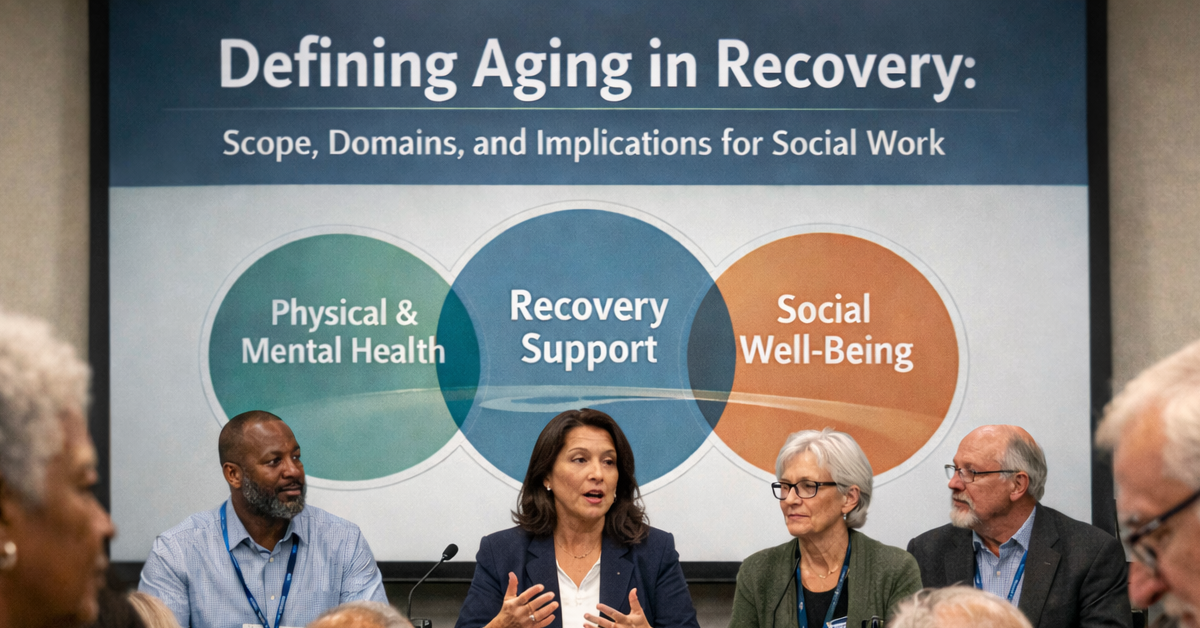
Scope, Domains, and Implications for Social Work
Abstract
While recovery has been extensively studied in early and mid-stage phases, little attention has been given to its long-term trajectory across the lifespan. This article formally defines Aging in Recovery as a field of practice, outlining its scope, core domains, and implications for research, policy, and service delivery. It positions the Aging in Recovery Response Model (ARRM) as one framework within this field and calls for the development of infrastructure to support a growing but structurally invisible population.
Introduction: From Concept to Field
Aging in Recovery has emerged not as a theoretical abstraction, but as a demographic and clinical reality. Advances in medicine, treatment, and recovery support systems have enabled individuals to sustain recovery for decades, resulting in increasing numbers of people entering older adulthood in long-term recovery.
Despite this shift, no formal field has been established to:
- Study this population
- Identify its needs
- Develop corresponding services
- Inform policy
As a result, individuals aging in recovery remain unrecognized within existing systems, falling between substance use treatment, mental health services, and aging care.
This article defines Aging in Recovery as a distinct field of practice and outlines its foundational components.
Defining Aging in Recovery as a Field
Aging in Recovery is defined as:
A field of practice and inquiry focused on understanding, supporting, and responding to the long-term trajectories of individuals who sustain recovery from substance use disorders across the lifespan and into older adulthood.
This field exists at the intersection of:
- Recovery science
- Aging and gerontology
- Behavioral health
- Social policy
- Community and mutual aid systems
Why a New Field Is Necessary?
Existing systems are not designed to address long-term recovery across decades.
Limitations of Current Frameworks
- Treatment systems focus on acute intervention and early recovery
- Mental health systems focus on diagnosable conditions
- Aging services focus on general aging populations without recovery-specific considerations
As a result:
Individuals in long-term recovery become structurally invisible once they stabilize.
Core Characteristics of the Population
Individuals aging in recovery often:
- Maintain long-term sobriety (10+ years)
- Achieve stability in housing, employment, and relationships
- Participate in mutual aid or self-directed recovery
- No longer meet criteria for formal services
However, they continue to experience:
- Long-term physical health effects of substance use
- Psychological and emotional regulation challenges
- Trauma-related impacts
- Aging-related vulnerabilities
Recovery, therefore, remains an active, ongoing process.
Core Domains of Aging in Recovery Practice
To establish Aging in Recovery as a field, it must be organized into practice domains.
1. Health and Biological Aging
This domain examines the interaction between:
- Long-term substance use histories
- Chronic disease development
- Neurological and cognitive changes
Research indicates that individuals with SUD histories experience higher rates of:
- Cardiovascular disease
- Liver disease
- Cognitive impairment (Kuerbis et al., 2014)
This domain requires integration between recovery-informed care and geriatric health services.
2. Psychological and Emotional Continuity
Recovery involves long-term management of:
- Trauma
- Emotional regulation
- Identity development
As individuals age, these processes intersect with:
- Loss
- Life transitions (e.g., retirement)
- Changing roles and identity
This domain emphasizes the need for lifespan-oriented mental health support.
3. Social Connection and Community
Mutual aid systems such as Alcoholics Anonymous and Narcotics Anonymous provide long-term community support.
However, aging introduces new challenges:
- Loss of peers
- Mobility limitations
- Reduced access to meetings
Research on aging populations highlights increased risk of isolation and depression (Blazer & Wu, 2009).
4. Identity and Purpose Across the Lifespan
Many individuals in recovery construct identities around:
- Work
- Family
- Service
As they age, particularly in retirement, questions emerge:
- Who am I without these roles?
- What sustains purpose now?
This domain focuses on identity continuity and transformation.
5. Recovery Continuity and Sustainability
Recovery is not a static state. It requires:
- Ongoing engagement
- Adaptive strategies
- Environmental support
Studies indicate that long-term recovery is associated with improved outcomes but still requires maintenance (Kelly et al., 2017).
This domain emphasizes sustaining recovery beyond traditional milestones.
ARRM Within the Field
The Aging in Recovery Residential Model (ARRM) is a developing practice framework situated within the emerging field of Aging in Recovery.
ARRM is not a general concept or an abstract response—it is a structural model intended to guide the design of recovery-informed residential and community-based environments for individuals in long-term recovery entering later life.
It provides:
- A framework for designing recovery-informed living environments
- A model for continuity of care beyond initial stabilization
- A structure for integrating peer support, community, and non-clinical services into long-term living arrangements
ARRM Core Principle
Existing systems are designed to initiate recovery, but not to sustain individuals in recovery as they age.
Implications for Social Work Practice
The development of ARRM requires a shift in how social work conceptualizes long-term recovery and stability in later life.
1. Expansion of Practice Scope
Social work must move beyond crisis intervention and early recovery models to address:
- Long-term recovery maintenance
- Aging-related transitions within recovery populations
- Stability as an ongoing, evolving process rather than a fixed outcome
2. Residential and Environmental Focus
Practice must extend into the design and support of environments that sustain recovery, including:
- Recovery-informed residential settings
- Community-based living models
- Supportive environments that reduce isolation and risk of relapse
3. Cross-System Alignment
ARRM requires coordination across systems that have historically operated independently, including:
- Substance use services
- Mental health care
- Aging and long-term care systems
Positioning of ARRM
ARRM represents a shift from episodic care models toward continuity-based, environment-centered support, recognizing that long-term recovery requires not only treatment, but sustained conditions that support dignity, connection, and stability over time.
Implications for Policy and Research
Policy
- Recognition of Aging in Recovery as a distinct population
- Development of integrated service models
- Inclusion in funding and program design
Research
- Longitudinal studies on recovery across the lifespan
- Examination of aging-specific needs
- Development of evidence-based interventions
Conclusion
Aging in Recovery represents a new and necessary field of practice within social work and behavioral health.
It reflects a fundamental shift:
- From crisis to continuity
- From intervention to lifespan support
- From visibility to recognition
As individuals live longer in recovery, the absence of a formal field becomes increasingly significant. The task ahead is not simply to acknowledge this population, but to:
- Define it
- Study it
- Build systems to support it
Aging in Recovery is no longer an emerging concept; it is an emerging field.
References
Blazer, D. G., & Wu, L. T. (2009). Substance use disorders in later life. American Journal of Psychiatry, 166(10), 1162–1169.
Kelly, J. F., Greene, M. C., & Bergman, B. G. (2017). Recovery from substance use disorder. Drug and Alcohol Dependence, 181, 162–169.
Kuerbis, A., et al. (2014). Substance abuse among older adults. Clinical Geriatric Medicine, 30(3), 629–654.
Substance Abuse and Mental Health Services Administration (SAMHSA). (2020). National Survey on Drug Use and Health.