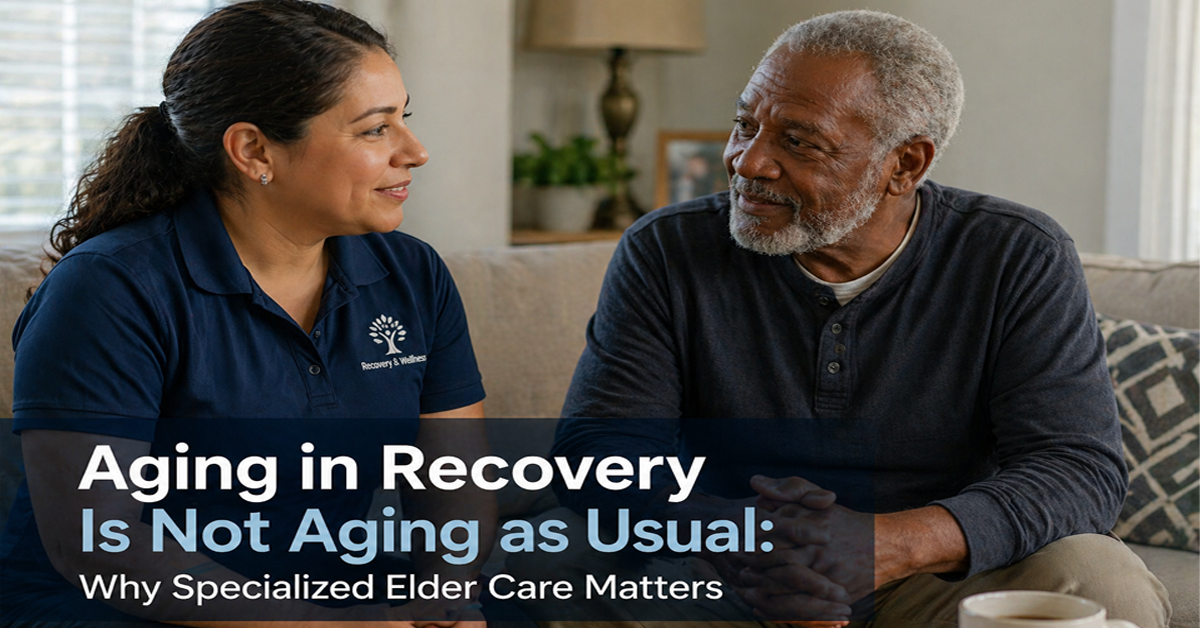
Why the Aging in Recovery Residential Model (ARRM) Is a Necessary Systems Response
Abstract
A common argument against specialized services for people aging in recovery (AIR) is that older adults in long-term recovery experience the same age-related conditions as the general population and can therefore use standard elder-care systems without modification. While superficially appealing, this position overlooks the cumulative biopsychosocial realities of substance use disorder (SUD), the long-term effects of trauma and stigma, the fragility of recovery capital, and the unique environmental factors that sustain remission over time. Research consistently demonstrates that older adults with present or past SUD histories often require coordinated, trauma-informed, recovery-oriented, and peer-integrated services rather than generic aging services alone. This article argues that AIR constitutes a distinct service population and that the Aging in Recovery Residential Model (ARRM) provides a practical, systems-level framework for housing, home care, long-term care, and community supports.
Introduction
The statement that people aging in long-term recovery simply face “normal aging” and therefore need no specialized services reflects a misunderstanding of both aging and recovery. It assumes that abstinence or remission erases decades of health, social, and structural consequences associated with addiction. It also assumes that traditional elder-care systems are adequately prepared to understand relapse risk, peer support, stigma sensitivity, medication concerns, social isolation, and the importance of recovery culture.
Recovery is not merely the absence of substance use. The Substance Abuse and Mental Health Services Administration defines recovery as a process of change through which individuals improve health and wellness, live self-directed lives, and strive to reach full potential (SAMHSA, 2025).
The False Equivalency of Same Ailments = Same Needs
It is true that older adults in recovery may develop arthritis, diabetes, mobility loss, cardiovascular disease, bereavement, or cognitive decline just like anyone else. But identical diagnoses do not mean identical service needs.
Two 72-year-olds may both need help with bathing, meal preparation, and transportation. Yet if one has 35 years in recovery, attends mutual-aid meetings, avoids mood-altering medications, depends on peer fellowship, fears institutional triggers, and carries trauma from incarceration or family estrangement, the care plan cannot be considered identical.
Long-Term Consequences of Substance Use Do Not Disappear at Retirement Age
Research shows that older adults with SUD histories often present with complex health and functional needs. SAMHSA’s Treatment Improvement Protocol on older adults notes that SUD is a chronic condition and that older adults may develop increased physical and psychosocial needs requiring coordinated supports across life domains (SAMHSA, 2020).
These may include:
• Liver, cardiac, neurological, or pulmonary sequelae from past use
• Chronic pain complicated by relapse concerns regarding opioids or sedatives
• Depression, anxiety, or trauma histories
• Cognitive changes that may threaten medication adherence or meeting attendance
• Social isolation after loss of spouse, friends, or mobility
• Shame and stigma that reduce help-seeking
Recovery Capital Can Decline in Later Life
Recovery capital refers to the internal and external resources that sustain recovery: housing, purpose, peers, transportation, structure, spiritual connection, family ties, and health care. Many older adults in long-term recovery lose key recovery assets through aging itself:
• They stop driving
• Friends in recovery die or relocate
• Fixed incomes limit meeting access
• Physical disability reduces community participation
• Widowhood increases loneliness
• Institutional placement separates them from recovery networks
Traditional Elder Services Often Lack Recovery Competence
The claim that existing nursing homes, assisted living settings, and home care systems are sufficient assumes these systems are recovery-informed. Frequently, they are not.
Common gaps may include:
• Staff unfamiliarity with relapse warning signs
• Casual attitudes toward alcohol in facilities
• Lack of understanding regarding mutual-aid participation
• Inappropriate medication practices without addiction sensitivity
• No peer specialists or SUD-trained lay workers
• Stigmatizing language
• Failure to integrate behavioral health and aging services
Recent research found a disconnect between the treatment needs of older adults with SUDs and available services, noting insufficient workforce training and limited specialized programming (Tailoring Treatment for Substance Use Disorders in Older Adults, 2025).
Why Peer Support Matters in Later Life
Peer support is not an optional add-on. For many people in long-term recovery, peers are the protective factor that sustains life itself.
Older adults may trust someone with lived experience more readily than professionals alone. Peer workers can assist with re-engagement after hospitalization, escort to meetings, shame reduction, systems navigation, wellness coaching, and social reconnection. SAMHSA identifies peer support as a core dimension of recovery (SAMHSA, 2025).
The Aging in Recovery Residential Model (ARRM)
ARRM is a systems framework proposing that residential and home-based environments should actively support long-term recovery rather than remain neutral or inadvertently harmful.
Its core pillars include:
1. Recovery-Informed Environment
2. Coordinated Continuum of Care
3. Peer and Workforce Supports
4. Individual Dignity and Self-Determination
5. Community Connection
ARRM asserts that the environment itself can either stabilize or destabilize recovery.
Why Social Work Should Lead
This issue falls squarely within the historic mission of social work: person-in-environment, systems reform, dignity, health equity, and vulnerable populations.
Social workers are uniquely positioned to conduct AIR assessments, build discharge plans that protect recovery capital, train elder-care staff, design peer-inclusive programs, and advocate for reimbursement innovations.
Conclusion
People aging in recovery are not asking for privilege. They are asking that systems recognize reality. Many survived overdose eras, incarceration, homelessness, HIV, family rupture, stigma, and premature death predictions. They then did the difficult work of sustaining recovery for decades. To tell them in old age that generic systems are enough ignores both evidence and human experience. ARRM offers a rational next step: build elder systems that understand recovery, not merely tolerate it.
References
National Association of Social Workers. (2021). Code of Ethics of the National Association of Social
Workers.
https://www.socialworkers.org/About/Ethics/Code-of-Ethics/Code-of-Ethics-English
Substance Abuse and Mental Health Services Administration. (2020). Treating substance use disorder in older adults: TIP 26.
https://library.samhsa.gov/product/tip-26-treating-substance-use-disorder-older-adults/pep20-02-01-011
Substance Abuse and Mental Health Services Administration. (2025). Recovery and recovery support.
https://www.samhsa.gov/substance-use/recovery
Substance Abuse and Mental Health Services Administration. (2025). Resources for older adults.
https://www.samhsa.gov/communities/older-adults
Schachman, K. A. (2025). Gaining Recovery in Addiction for Community Elders (GRACE) Project.
Journal of Applied Gerontology.
https://journals.sagepub.com/doi/10.1177/10783903241261694
Tailoring Treatment for Substance Use Disorders in Older Adults. (2025). PubMed Central.
https://pmc.ncbi.nlm.nih.gov/articles/PMC12188435/