Abstract
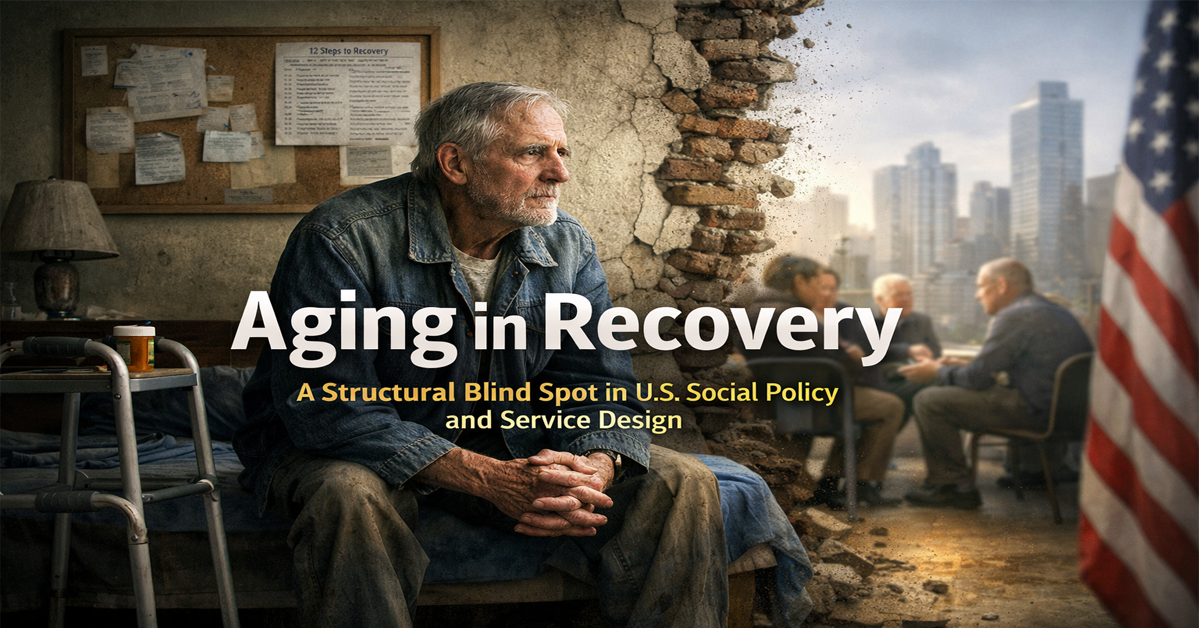
A growing population of older adults in the United States is aging after decades of sustained recovery from substance use disorders (SUDs). Despite this demographic reality, existing service systems—aging services and behavioral health—have evolved independently, resulting in a structural gap in care. This article examines the historical and policy foundations of this divide, analyzes the limitations of current service models, and advances “Aging in Recovery” as an emerging field requiring integrated system design. Drawing on social work theory, public health research, and policy analysis, this paper argues that the absence of recovery-informed aging frameworks represents a significant oversight in contemporary service delivery.
Introduction
Social work is grounded in the person-in-environment framework, which emphasizes that individual outcomes are inseparable from the social, institutional, and policy contexts in which individuals exist (Hutchison, 2019). When systems fail to evolve in response to changing populations, the resulting gaps are not incidental—they are structural.
One such structural gap is now emerging with increasing clarity – aging in recovery.
Over the past four decades, significant numbers of individuals have achieved long-term recovery from substance use through a combination of peer-based support, treatment, and community engagement (White, 2009). Many of these individuals are now entering older adulthood. However, the systems designed to support older adults—home care, assisted living, and long-term care—were not developed with this population in mind.
At the same time, behavioral health systems have historically focused on early recovery and acute treatment, with limited attention to long-term recovery trajectories across the lifespan (Substance Abuse and Mental Health Services Administration [SAMHSA], 2020).
The result is a population that exists between systems—recognized by neither, fully supported by neither.
Historical Context: The Development of Parallel Systems
The structural gap between aging and recovery systems can be traced to their separate historical development.
Behavioral health policy in the United States has long been shaped by shifting perspectives on substance use, alternating between criminalization and treatment (Courtwright, 2010). Throughout much of the 20th century, addiction was framed as a social threat requiring control, leading to punitive policies that prioritized enforcement over care.
At the same time, peer-based recovery movements—such as Narcotics Anonymous—developed outside formal institutions, providing sustained support through community-based, non-clinical approaches (White, 2009). These models emphasized continuity, identity, and mutual aid, often filling gaps left by formal systems.
In contrast, aging services in the United States evolved through a public health and social welfare framework focused on physical decline, chronic illness, and functional impairment. The creation of Medicare and Medicaid in 1965, along with the Older Americans Act, established a foundation for services addressing medical and supportive care needs among older adults (Administration for Community Living [ACL], 2022).
These systems were not designed to intersect.
Behavioral health systems addressed acute and early-stage needs. Aging services addressed late-life physical and functional decline. Neither system was structured to address individuals aging after decades of sustained recovery.
Policy and Systems Analysis: A Structural Disconnect
From a systems perspective, the absence of integration between aging and recovery frameworks represents a fundamental design limitation.
Research consistently demonstrates that peer-based recovery support is associated with improved long-term outcomes, including reduced relapse rates, increased social support, and enhanced quality of life (Tracy & Wallace, 2016; White, 2009). Despite this evidence, peer recovery models have historically remained peripheral to formal service systems.
Policy frameworks have tended to prioritize
* Clinical treatment models
* Institutional care settings
* Regulatory standardization
While these approaches have contributed to professionalization and oversight, they have also limited the incorporation of community-based and non-clinical supports.
As individuals age, this limitation becomes more pronounced.
Entry into aging systems—such as home care or assisted living—often results in a loss of recovery-informed supports. Staff may be trained in physical care but lack familiarity with recovery principles, including the importance of routine, peer connection, and environmental stability.
This reflects a broader issue: policy has not kept pace with practice.
Aging in Recovery as a Distinct Field
The concept of aging in recovery seeks to define and address this structural gap.
Rather than viewing recovery as a discrete phase, this framework recognizes recovery as a lifelong process shaped by changing conditions over time. As individuals age, the factors supporting recovery—social networks, physical health, access to resources—also change.
This aligns with the concept of recovery capital, which emphasizes the role of social, physical, and human resources in sustaining recovery (Cloud & Granfield, 2008).
In older adulthood
* Social capital may diminish due to loss, mobility limitations, or reduced engagement
* Physical capital may be constrained by fixed income or increased healthcare needs
* Human capital may be affected by health decline or cognitive changes
These shifts require adaptation at the systems level.
Aging in recovery, therefore, should be understood not simply as a population descriptor, but as a framework for system design—one that integrates behavioral health, aging services, and community-based support.
Implications for Policy and Service Design
Addressing this structural gap requires coordinated changes across multiple levels of policy and practice.
1. Integration of Behavioral Health and Aging Services
Current service models often operate in silos. Greater integration is needed to ensure that behavioral health considerations are incorporated into aging services and vice versa (Institute of Medicine, 2012).
2. Recognition of Peer Support as Essential Infrastructure
Peer-based recovery should be formally recognized as a core component of long-term support, rather than an adjunct to clinical care.
3. Workforce Development
Training for caregivers and service providers should include recovery-informed approaches, enabling staff to recognize and respond to the needs of individuals in long-term recovery.
4. Expansion of Home-Based Models
Home-based care offers a flexible platform for integrating recovery-informed support, particularly for individuals seeking to maintain independence while preserving stability.
5. Data and Research Development
The absence of systematic data on individuals aging in recovery limits the ability to design effective policy. Research must begin to identify this population as a distinct group.
Conclusion
Aging in recovery represents a structural blind spot in U.S. social policy and service design.
A population that has achieved long-term recovery is now entering systems not designed to meet its needs. The resulting gaps are not the result of individual failure, but of system fragmentation.
Recognizing aging in recovery as an emerging field provides an opportunity to realign policy with practice, integrate existing systems, and develop models that reflect the realities of long-term recovery across the lifespan.
The issue is not whether this population exists.
The issue is whether systems will evolve to recognize and support it.
References
Administration for Community Living. (2022). *2021 profile of older Americans*. U.S. Department of Health and Human Services.
Cloud, W., & Granfield, R. (2008). Conceptualizing recovery capital: Expansion of a theoretical construct. *Substance Use & Misuse, 43*(12–13), 1971–1986.
Courtwright, D. T. (2010). *Dark Paradise: A History of opiate addiction in America* (Updated ed.). Harvard University Press.
Hutchison, E. D. (2019). *Dimensions of human behavior: Person and environment* (6th ed.). SAGE Publications.
Institute of Medicine. (2012). *The mental health and substance use workforce for older adults, in whose hands?* National Academies Press.
Substance Abuse and Mental Health Services Administration. (2020). *TIP 63 Medications for opioid use disorder*. U.S. Department of Health and Human Services.
Tracy, K., & Wallace, S. P. (2016). Benefits of peer support groups in the treatment of addiction. *Substance Abuse and Rehabilitation, 7*, 143–154.
White, W. L. (2009). *Peer-based addiction recovery support: History, theory, practice, and scientific evaluation*. Great Lakes Addiction Technology Transfer Center.