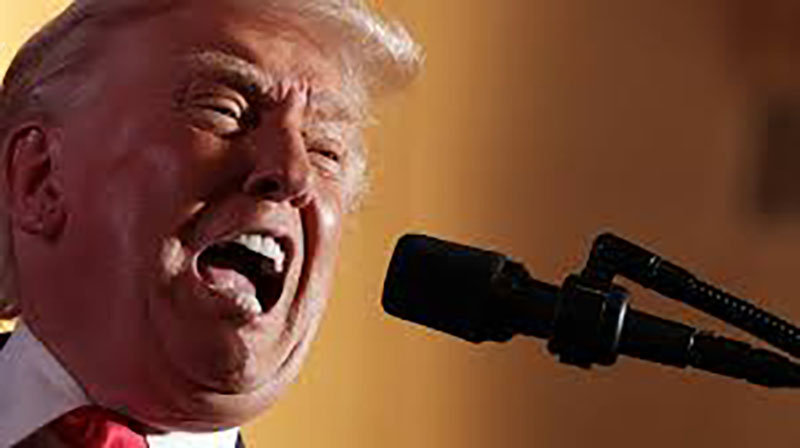
Irrational Thought Syndrome (ITS) on Full Display
Donald Trump and his allies often accuse critics of suffering from “Trump Derangement Syndrome,” a label meant to suggest emotional instability and irrational obsession. But if we strip away the rhetoric and instead look at observable behavior—especially Trump’s own words—we see something far more troubling and far more concrete: a persistent pattern of irrational thinking, conspiracy framing, and factual instability. What can accurately be described as Irrational Thought Syndrome (ITS).
ITS is not a medical diagnosis. It is a descriptive term for a repeated mode of reasoning—one that Trump himself increasingly exemplifies.
CONSPIRACY FIRST, REALITY SECOND
Trump recently made a reckless and deeply irresponsible statement involving filmmaker Rob Reiner and Reiner’s wife, invoking the idea of murder in a way that appeared untethered from reality or evidence. There was no factual basis, no corroboration, no clarification—only insinuation. This is a hallmark of ITS: the casual escalation from disagreement to imagined criminality, with no concern for truth or consequence.
This pattern is familiar. Political opponents are not wrong; they are evil. Critics are not mistaken; they are criminals. Disagreement becomes evidence of hidden violence. Facts are unnecessary once the narrative “feels” right.
THE VENEZUELAN BOAT INCIDENT: A MOVING TARGET
Equally revealing is Trump’s flip-flopping commentary surrounding the deaths of two Venezuelan survivors clinging to a capsized fishing boat after it was attacked. His remarks shifted—first minimizing responsibility, then reframing the victims, then changing the moral framing altogether.
This is not confusion. It is epistemic instability—another defining feature of ITS. The facts do not guide the narrative; the narrative reshapes the facts in real time, depending on political convenience. Victims become suspects. Accountability becomes persecution. Sympathy is conditional.
ALTERNATE FACTS AS A WORLDVIEW
At the core of ITS is the belief that reality itself is negotiable. Trump’s public statements increasingly demonstrate this: courts are corrupt when they rule against him, fair when they don’t; elections are rigged only when he loses; violence is condemned or excused depending on who commits it.
This is not skepticism. Skepticism demands evidence and accepts correction. ITS rejects evidence outright, replacing it with emotional certainty and grievance-based logic.
PERSECUTION AS PROOF
Perhaps the most dangerous element of ITS is the belief that opposition itself proves righteousness. If Trump is criticized, it confirms the conspiracy. If he is challenged, it validates his worldview. Accountability becomes evidence of a cover-up.
This closed-loop reasoning makes rational discourse impossible. No fact can penetrate it. No contradiction matters.
A MIRROR HELD UP
The irony is unavoidable: the very people who popularized “Trump Derangement Syndrome” as an insult now refuse to acknowledge the far more visible derangement in Trump’s own thinking. ITS does not describe obsession with Trump. It describes Trump’s own repeated detachment from evidence, consistency, and reality.
Words matter—especially from someone seeking power again. When conspiracy replaces fact, when victims are redefined to fit narratives, and when murder is casually invoked against critics, the issue is no longer partisan outrage. It is cognitive dysfunction at the highest level of public life.
Call it what it is: Irrational Thought Syndrome.
1) ITS — Irrational Thought Syndrome
DEFINITION
Irrational Thought Syndrome (ITS) refers to a persistent pattern of cognitive processing marked by resistance to verifiable evidence, reliance on unfalsifiable beliefs, and emotional reasoning overriding factual analysis—particularly in political and social contexts.
ITS is not a medical or psychiatric diagnosis, but a descriptive term used to identify recurring reasoning patterns observable in public discourse.
CORE CHARACTERISTICS
1. Conspiracy-Dominant Cognition
Default assumption that events are controlled by hidden actors
Beliefs persist even when predictions repeatedly fail
Lack of falsifiability (“any evidence against it proves the conspiracy”)
2. Acceptance of “Alternate Facts”
Preference for claims aligned with identity or ideology over empirical data
Rejection of established verification methods (courts, audits, peer review)
3. Epistemic Reversal
Treating opinion as evidence
Treating evidence as propaganda
Equating emotional conviction with truth
4. Source Absolutism
Total distrust of all mainstream or institutional sources
Uncritical trust in a narrow set of ideologically aligned outlets or figures
5. Persecution Interpretation
Viewing accountability, legal processes, or criticism as coordinated attacks
Framing consequences as proof of correctness
BEHAVIORAL MANIFESTATIONS
Repetition of identical claims across unrelated contexts
Shifting standards of proof depending on who benefits
Inability to revise beliefs when confronted with contradictory facts
Moral certainty paired with factual indifference
DIFFERENTIATION FROM HEALTHY SKEPTICISM
Skepticism asks for evidence and is willing to change conclusions.
ITS dismisses evidence categorically and treats belief itself as validation.
Why the Term Is Legitimate (by the Same Logic as TDS- Trump Derangement Syndrome)
It names a pattern, not a diagnosis
It is descriptive, not clinical
It is used rhetorically to explain behavior, not to pathologize individuals
It applies regardless of party or ideology, though often observed in highly polarized environments
CLARIFYING STATEMENT
Use of the term ITS does not imply mental illness.
It describes a mode of reasoning, not a medical condition—exactly as defenders of TDS claim for that label.
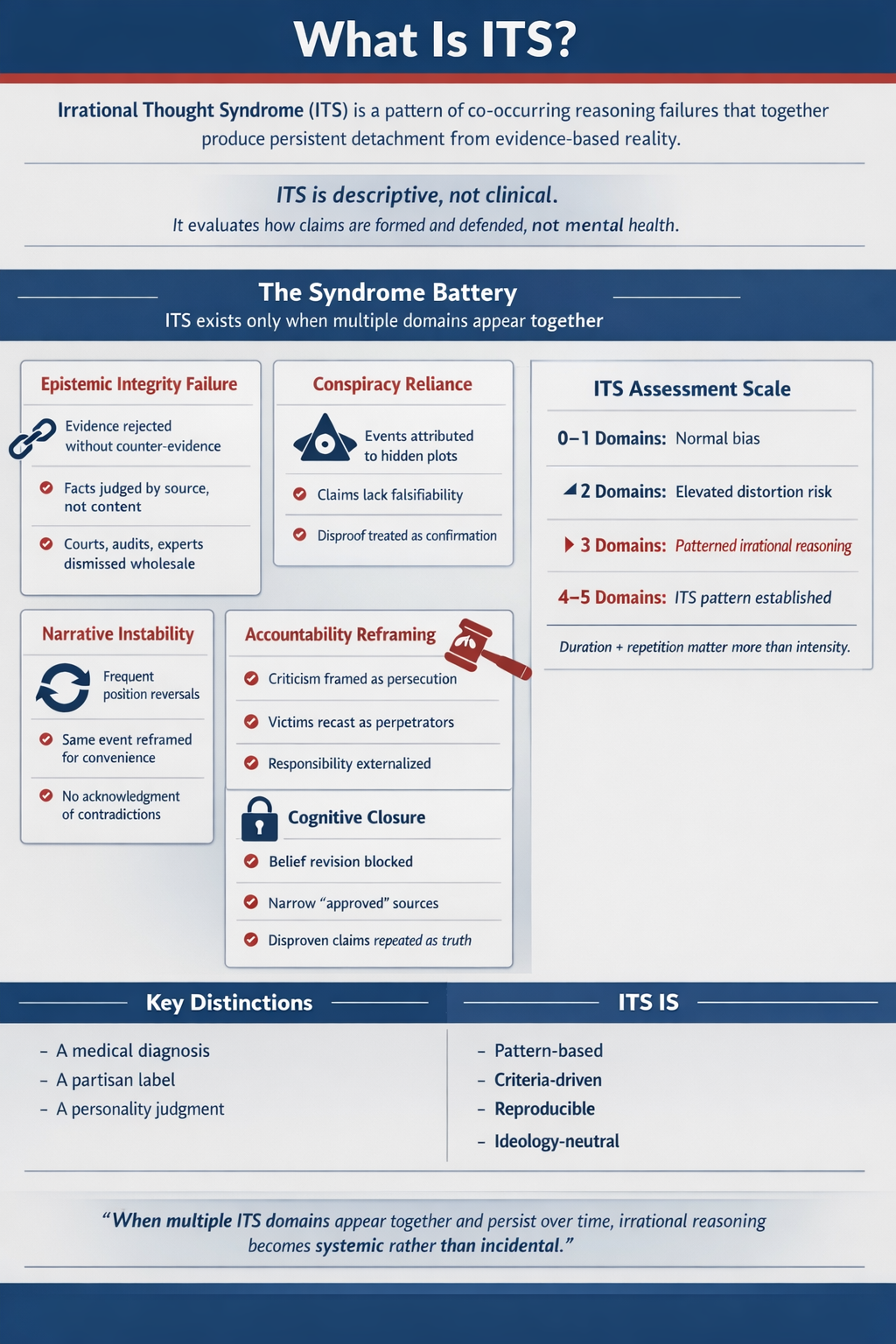
2) IRRATIONAL THOUGHT SYNDROME (ITS)
WHAT IS IRRATIONAL THOUGHT SYNDROME (ITS)
ITS is a Formal Analytic Framework for Evaluating Public Discourse
PURPOSE
The ITS framework is designed to analyze patterns of reasoning in public statements, not to diagnose individuals. It evaluates how claims are formed, justified, revised, and defended over time.
It is especially useful in analyzing:
• Political rhetoric
• Media narratives
• Public leadership communication
• Crisis response statements
FRAMEWORK STRUCTURE
The ITS framework consists of five core domains, each with operational indicators.
A subject exhibits ITS only when multiple domains are present simultaneously and persistently.
Domain I — Epistemic Integrity
Question: How does the subject treat evidence?
Indicators
Rejects verifiable evidence without counter-evidence
Elevates personal belief above documented facts
Dismisses institutions wholesale (courts, audits, journalism) rather than disputing specific findings
Failure Mode:
Evidence is judged by who presents it, not by what it shows.
Domain II — Conspiracy Reliance
Question: How are unexplained or unfavorable events interpreted?
Indicators
Recurrent attribution to hidden actors or plots
Claims lack falsifiability (no condition under which they would be disproven)
Contradictory facts are absorbed as proof of conspiracy
Failure Mode:
Absence of evidence becomes evidence itself.
Domain III — Narrative Stability
Question: Are explanations consistent over time?
Indicators
Frequent position reversals without acknowledgment
Reframing the same event differently depending on political utility
Retroactive rewriting of prior statements
Failure Mode:
Narrative convenience overrides factual continuity.
Domain IV — Accountability Reframing
Question: How is criticism or consequence interpreted?
Indicators
Legal, ethical, or factual challenges portrayed as persecution
Victims recharacterized as aggressors
Responsibility externalized to enemies, systems, or conspiracies
Failure Mode:
Accountability is treated as hostility.
Domain V — Cognitive Closure
Question: Is belief revision possible?
Indicators
Preemptive dismissal of opposing information
Narrow set of “approved” sources immune from scrutiny
Repetition of disproven claims as settled truth
Failure Mode:
The reasoning system becomes self-sealing.
SCORING / THRESHOLD MODEL
This framework is non-binary.
0–1 domains: Normal political bias or rhetorical exaggeration
2 domains: Elevated distortion risk
3 domains: Patterned irrational reasoning
4–5 domains: ITS pattern established
Duration and repetition matter more than intensity.
METHOD OF APPLICATION
1. Collect Statements
Use public quotes, transcripts, or verified reporting.
2. Map Statements to Domains
Identify which indicators are present.
3. Assess Persistence
Determine whether patterns recur over time.
4. Evaluate Co-Occurrence
Confirm multiple domains appear together.
5. Draw Conclusions
Describe the reasoning pattern, not the person.
KEY DISTINCTIONS
• Not a medical diagnosis
• Not a personality judgment
• Not ideology-specific
• Applies equally across political affiliations
ITS evaluates reasoning behavior, not beliefs themselves.
WHY THIS FRAMEWORK IS DEFENSIBLE
• Pattern-based
• Criteria-driven
• Reproducible
• Transparent
• Non-clinical
It meets the same analytical standards used in:
• Media literacy research
• Propaganda analysis
• Cognitive bias assessment
• Political psychology (without diagnosis)
Use Case Example
“When evaluated using the ITS analytic framework, the subject’s repeated conspiracy framing, narrative reversals, and rejection of evidentiary standards demonstrate a sustained pattern of irrational thought.”
___________
Note: Irrational Thought Syndrome (ITS) is a term originally coined by Gilberto Cintron, LMSW, as a descriptive framework for identifying defective reasoning patterns in public discourse. It is not a clinical diagnosis and should not be confused with any psychiatric or medical condition.