Abstract
Addiction policy in the United States has been shaped by a persistent tension between public health approaches and punitive control. Early efforts to address substance use through treatment were quickly overshadowed by enforcement-driven policies that prioritized incarceration and regulation. This article examines the historical trajectory of addiction policy—from early treatment initiatives such as the Narcotic Addiction Control Commission (NACC), to the expansion of punitive frameworks under New York’s Rockefeller Drug Laws, and the national escalation of the War on Drugs under President Richard Nixon. It further analyzes how these policy decisions marginalized peer-based recovery models and contributed to long-term structural gaps, including the absence of recovery-informed care within aging systems. The article argues that the failure to align policy with effective practice continues to shape service delivery, particularly for individuals aging in recovery.
Introduction
Public policy plays a central role in defining how social problems are understood and addressed. In the case of substance use, U.S. policy has historically reflected competing frameworks—one viewing addiction as a medical condition requiring treatment, and another framing it as a moral or criminal issue requiring control (Courtwright, 2010).
This tension has not been resolved. Instead, it has produced a fragmented system in which treatment and punishment coexist, often without alignment.
The long-term consequences of this fragmentation are increasingly evident. A population that achieved recovery outside formal systems is now aging into service environments that do not recognize or support the mechanisms that sustained that recovery.
This outcome is not incidental. It is rooted in policy.
Early Treatment Efforts and the Shift Toward Control
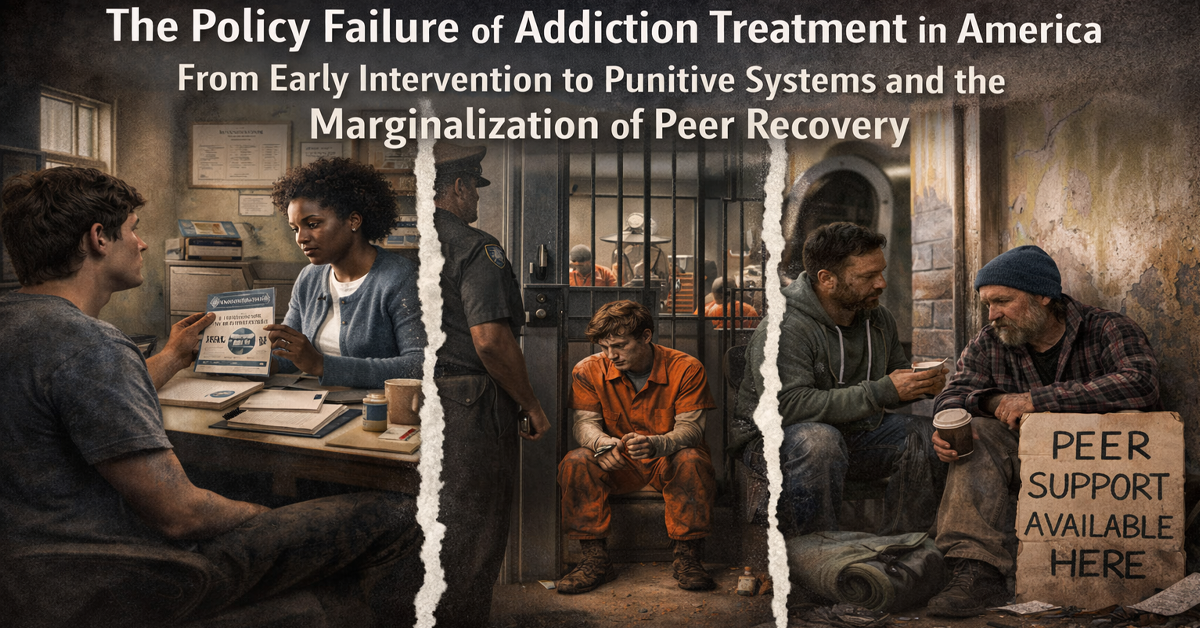
In the mid-20th century, there were attempts to approach addiction through treatment-oriented frameworks. In New York State, the establishment of the Narcotic Addiction Control Commission (NACC) reflected an early effort to address substance use through structured intervention rather than solely through criminalization (Schneider, 2008).
However, these efforts were short-lived in their original intent.
Under the leadership of Nelson Rockefeller, addiction policy underwent a significant transformation. The Rockefeller Drug Laws of the 1970s introduced mandatory sentencing for drug-related offenses, emphasizing incarceration as a primary response (Hinton, 2016).
This marked a decisive shift
-
- From treatment to punishment
- From intervention to control
- From public health to criminal justice
The earlier treatment-oriented initiatives did not disappear entirely, but they became secondary within a broader punitive framework.
National Expansion: The War on Drugs
At the federal level, this shift was reinforced and expanded.
Under Richard Nixon, the War on Drugs formalized a national strategy that prioritized enforcement and interdiction (Courtwright, 2010). While Nixon publicly acknowledged addiction as a health issue, federal policy disproportionately emphasized law enforcement responses.
Subsequent administrations continued and intensified this approach, resulting in
- Increased incarceration rates
- Expansion of the criminal justice system
- Limited investment in long-term recovery infrastructure
These policies shaped not only the legal landscape but also the development of service systems.
The Marginalization of Peer-Based Recovery
While formal policy structures emphasized control and clinical treatment, peer-based recovery movements were developing independently.
Organizations such as Narcotics Anonymous provided sustained support through community-based, non-clinical models rooted in shared experience. These approaches emphasized continuity, accountability, and identity, and they proved effective in supporting long-term recovery (White, 2009; Tracy & Wallace, 2016).
Despite their effectiveness, peer-based models were often excluded from formal systems.
In many state-operated facilities, these programs were
-
- Restricted or prohibited
- Viewed as unregulated
- Considered incompatible with institutional control
This exclusion reflects a broader pattern in policy development practices that emerge outside formal systems, which are often slow to be recognized, even when they demonstrate effectiveness.
Systems Analysis Policy–Practice Misalignment
From a systems perspective, the history of addiction policy reveals a persistent misalignment between policy and practice.
Research has consistently shown that recovery is a long-term process supported by social connection, routine, and community engagement (White, 2009). However, policy frameworks have tended to focus on
- Acute treatment episodes
- Institutional care
- Short-term outcomes
This creates a disconnect
-
- Practice supports long-term recovery
- Policy supports short-term intervention
The consequences of this misalignment are structural.
Systems designed around acute care are not equipped to support individuals over decades. As those individuals age, the limitations of this design become increasingly apparent.
Long-Term Consequences: The Emergence of a System Gap
The long-term effects of punitive and fragmented policy are now visible in the aging population.
Individuals who achieved recovery through peer-based systems are entering aging services that
- Do not incorporate recovery frameworks
- Lack of staff trained in recovery-informed care
- Prioritize physical needs over behavioral health stability
This results in
-
- Loss of access to recovery support
- Increased risk of isolation
- Misalignment between care environments and individual needs
From a policy perspective, this represents a delayed consequence of earlier decisions.
Systems that failed to integrate effective practices in the past are now unable to respond to emerging needs.
Implications for Policy and System Design
Addressing these issues requires a fundamental shift in policy orientation.
1. Recognition of Long-Term Recovery
Policy frameworks must acknowledge recovery as a lifelong process rather than a discrete treatment phase.
2. Integration of Peer-Based Models
Peer recovery should be incorporated into formal systems as a core component of care.
3. Cross-System Coordination
Aging and behavioral health systems must be aligned to address overlapping needs.
4. Investment in Community-Based Care
Home-based and community-based models offer a more flexible and effective platform for supporting long-term recovery.
5. Historical Reassessment
Policy development should account for the long-term consequences of past decisions, particularly the emphasis on punitive approaches.
Application to Aging in Recovery
The concept of aging in recovery provides a lens through which these policy failures can be understood.
This population exists at the intersection of two systems that have historically operated independently
- Behavioral health systems focused on early recovery
- Aging systems focused on late-life care
Bridging this gap requires
-
- Policy frameworks that account for lifespan trajectories
- Integration of recovery-informed practices into aging services
- Recognition of peer support as essential infrastructure
These changes reflect a shift from fragmented to integrated system design.
Conclusion
The history of addiction policy in the United States is characterized by a persistent tension between treatment and punishment.
While early efforts included treatment-oriented approaches, these were overshadowed by punitive policies that prioritized control over care. At the same time, effective peer-based recovery models were marginalized and excluded from formal systems.
The long-term consequences of these decisions are now evident.
A population that achieved sustained recovery is aging into systems that do not recognize or support the mechanisms that made that recovery possible.
Aligning policy with effective practice is not simply a matter of improvement—it is a necessary correction.
References
Courtwright, D. T. (2010). Dark Paradise: A History of opiate addiction in America (Updated ed.). Harvard University Press.
Hinton, E. (2016). From the war on poverty to the war on crime: The making of mass incarceration in America. Harvard University Press.
Schneider, E. (2008). Smack Heroin and the American City. University of Pennsylvania Press.
Substance Abuse and Mental Health Services Administration. (2020). Treatment Improvement Protocol (TIP) 63. U.S. Department of Health and Human Services.
Tracy, K., & Wallace, S. P. (2016). Benefits of peer support groups in the treatment of addiction.
Substance Abuse and Rehabilitation, 7, 143–154.
White, W. L. (2009). Peer-based addiction recovery support: History, theory, practice, and scientific evaluation. Great Lakes Addiction Technology Transfer Center.