Abstract
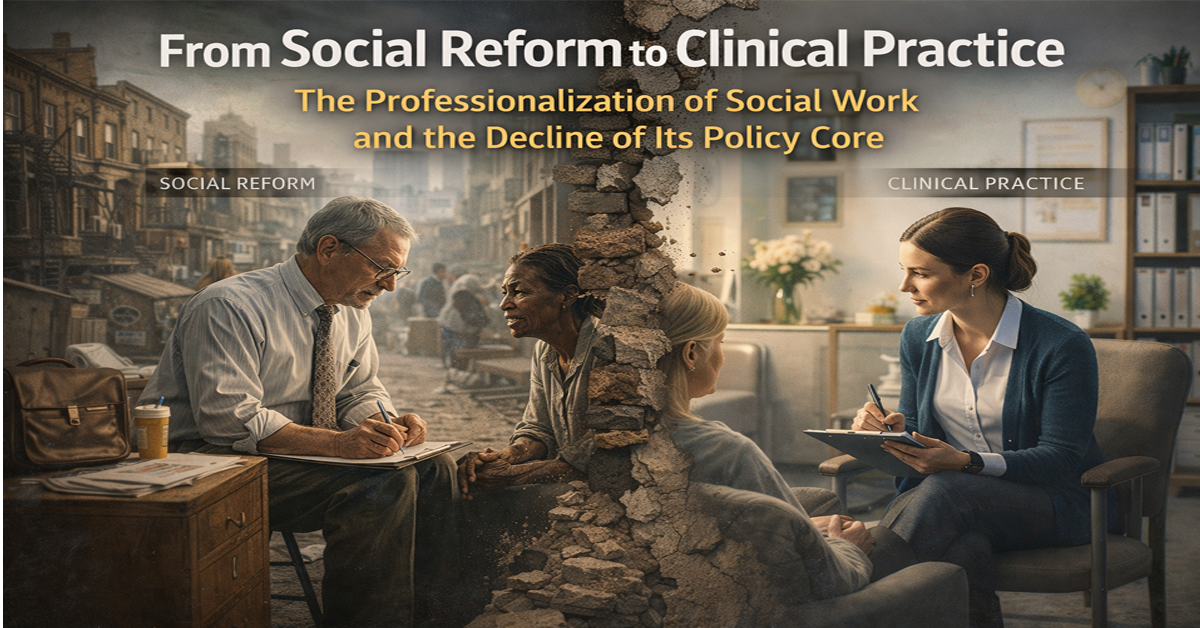
Social work originated as a reform-oriented profession grounded in social justice and structural change. Over the course of the 20th century, however, the field underwent a significant transformation toward individualized casework and clinical practice. While this shift enhanced professional legitimacy, it also reduced the emphasis on policy engagement and systems-level intervention. This article examines the historical evolution of social work from reform to clinical orientation, analyzes the consequences of this shift for contemporary practice, and explores how the diminished policy focus has contributed to gaps in addressing complex, cross-system issues such as aging in recovery.
Introduction
Social work has long been defined by its dual commitment to individual well-being and social reform. The profession’s foundation rests on the recognition that personal challenges are often rooted in broader structural conditions, including poverty, inequality, and systemic exclusion (Hutchison, 2019).
Over time, however, the balance between these commitments has shifted.
Contemporary social work practice is heavily oriented toward individualized intervention—assessment, diagnosis, and treatment—often within institutional settings. While this focus has strengthened the profession’s role within healthcare and behavioral health systems, it has also narrowed its engagement with policy and structural change.
The implications of this shift extend beyond professional identity. They shape the field’s capacity to respond to emerging social issues that do not fit neatly within existing service frameworks.
Historical Foundations of Social Work as a Reform Movement
Early social work in the United States was explicitly reform-driven.
Figures such as Dorothea Dix advocated for systemic changes in the treatment of individuals with mental illness, leading to the expansion of state-supported institutions (Grob, 1994). Similarly, Jane Addams and the settlement house movement focused on addressing the social determinants of poverty, including labor conditions, housing, and immigration (Addams, 1910).
These efforts were grounded in a clear understanding social problems were not solely individual in nature, but were shaped by structural forces.
Intervention, therefore, required both direct support and systemic change.
This orientation positioned social work as a key participant in broader reform movements, including public health, labor rights, and education.
The Emergence of Casework and Professionalization
The early 20th century marked a turning point in the development of social work.
The publication of *Social Diagnosis* by Mary Richmond (1917) introduced a systematic approach to understanding and addressing individual cases. Richmond’s work emphasized assessment, documentation, and methodical intervention, laying the foundation for modern casework.
At the same time, formal training programs began to emerge, including the New York School of Philanthropy, which later became associated with Columbia University (Austin, 1983). These programs emphasized scientific approaches and standardized methods, contributing to the professionalization of the field.
Professionalization brought several benefits
* Increased legitimacy
* Standardized training
* Greater integration into formal service systems
However, it also contributed to a shift in focus.
Attention moved
* From community conditions to individual pathology
* From advocacy to intervention
* From policy to practice
This transformation did not eliminate the profession’s reform-oriented roots, but it redefined its center of gravity.
The Decline of Policy Engagement
As social work became more closely aligned with clinical practice, its role in policy development and structural advocacy diminished.
Scholars have noted that the profession’s increasing integration into institutional systems—such as healthcare and mental health—shifted its focus toward service delivery rather than system design (Specht & Courtney, 1994). This alignment reinforced a model in which social workers addressed the consequences of social problems, rather than their underlying causes.
Several factors contributed to this shift
1. Institutional Integration
Employment within healthcare and social service organizations prioritized individual outcomes and measurable interventions.
2. Licensure and Professional Standards
The development of licensing requirements emphasized clinical competencies, further reinforcing micro-level practice.
3. Funding Structures
Reimbursement models favored direct services over policy work or community-based advocacy.
The cumulative effect was a profession increasingly oriented toward individual treatment.
Systems Consequences, Fragmentation, and Reactive Models
The decline in policy engagement has had significant implications for system design.
Without sustained involvement in policy development, social work has had limited influence on the structure of service systems. As a result, systems have evolved in fragmented ways, often lacking coordination across sectors.
This fragmentation is evident in areas such as
* Behavioral health and primary care
* Housing and healthcare
* Aging services and substance use treatment
In many cases, systems operate independently, addressing specific needs without considering broader intersections.
This leads to reactive models of care, in which services respond to problems after they emerge, rather than addressing the structural conditions that contribute to those problems.
Implications for Emerging Populations Aging in Recovery
The limitations of a primarily micro-focused approach are particularly evident in the case of aging in recovery.
This population does not fit within traditional service categories
* Not actively in treatment
* Not fully addressed by aging services
* Not recognized within existing policy frameworks
As a result, individuals aging in recovery often experience gaps in care that reflect system design rather than individual need.
From a policy perspective, this represents a failure to anticipate and respond to changing demographic realities.
Addressing these gaps requires
* Recognition of emerging populations
* Integration of service systems
* Engagement with policy and structural change
These are inherently macro-level functions.
Rebalancing the Profession Reintegrating Macro Practice
Rebalancing social work requires a renewed emphasis on macro-level engagement.
This does not require abandoning clinical practice. Rather, it involves integrating micro and macro perspectives to ensure that individual interventions are supported by effective systems.
Key areas for re-engagement include
* Policy Development
Participation in shaping legislation and service frameworks
* Systems Analysis
Identifying gaps and inefficiencies in existing structures
* Advocacy
Promoting equitable access to services and resources
* Interdisciplinary Collaboration
Working across sectors to address complex social issues
Reintegrating these elements strengthens the profession’s ability to address both individual and structural challenges.
Application to Aging in Recovery
Aging in recovery illustrates the need for this rebalancing.
Addressing the needs of this population requires
* Policy frameworks that recognize long-term recovery
* Integration of behavioral health and aging services
* Development of recovery-informed care models
These interventions extend beyond individual practice and into system design.
Without macro-level engagement, such changes are unlikely to occur.
Conclusion
The professionalization of social work represents both an advancement and a limitation.
While it has enhanced the field’s credibility and capacity for individualized intervention, it has also contributed to a reduced emphasis on policy and structural change.
As new social challenges emerge—particularly those that span multiple systems—the limitations of a primarily micro-focused approach become increasingly evident.
Reintegrating macro practice is not a return to the past. It is a necessary evolution that aligns the profession with its foundational principles.
Aging in recovery is one example of where this alignment is urgently needed.
References
Addams, J. (1910). *Twenty years at Hull-House*. Macmillan.
Austin, D. M. (1983). The Flexner myth and the history of social work. *Social Service Review, 57*(3), 357–377.
Grob, G. N. (1994). *The mad among us: A history of the care of America’s mentally ill*. Free Press.
Hutchison, E. D. (2019). *Dimensions of human behavior: Person and environment* (6th ed.). SAGE Publications.
Richmond, M. (1917). *Social diagnosis*. Russell Sage Foundation.
Specht, H., & Courtney, M. (1994). *Unfaithful angels: How social work has abandoned its mission*. Free Press.